How to Name My Company and Build a Brand
Before you even think about brainstorming names or checking if a domain is available, there's a crucial first step that too many founders skip: defining your brand identity. This isn't just marketing fluff; it's the foundation for everything. You have to get crystal clear on who you are, who you're for, and what you believe in. Get this right, and your name becomes a powerful strategic tool, not just a label you liked.
Want to turn this into real name ideas? Open Naming Toolbox to generate, refine, and compare naming options while you read.
Define Your Brand Before You Pick a Name
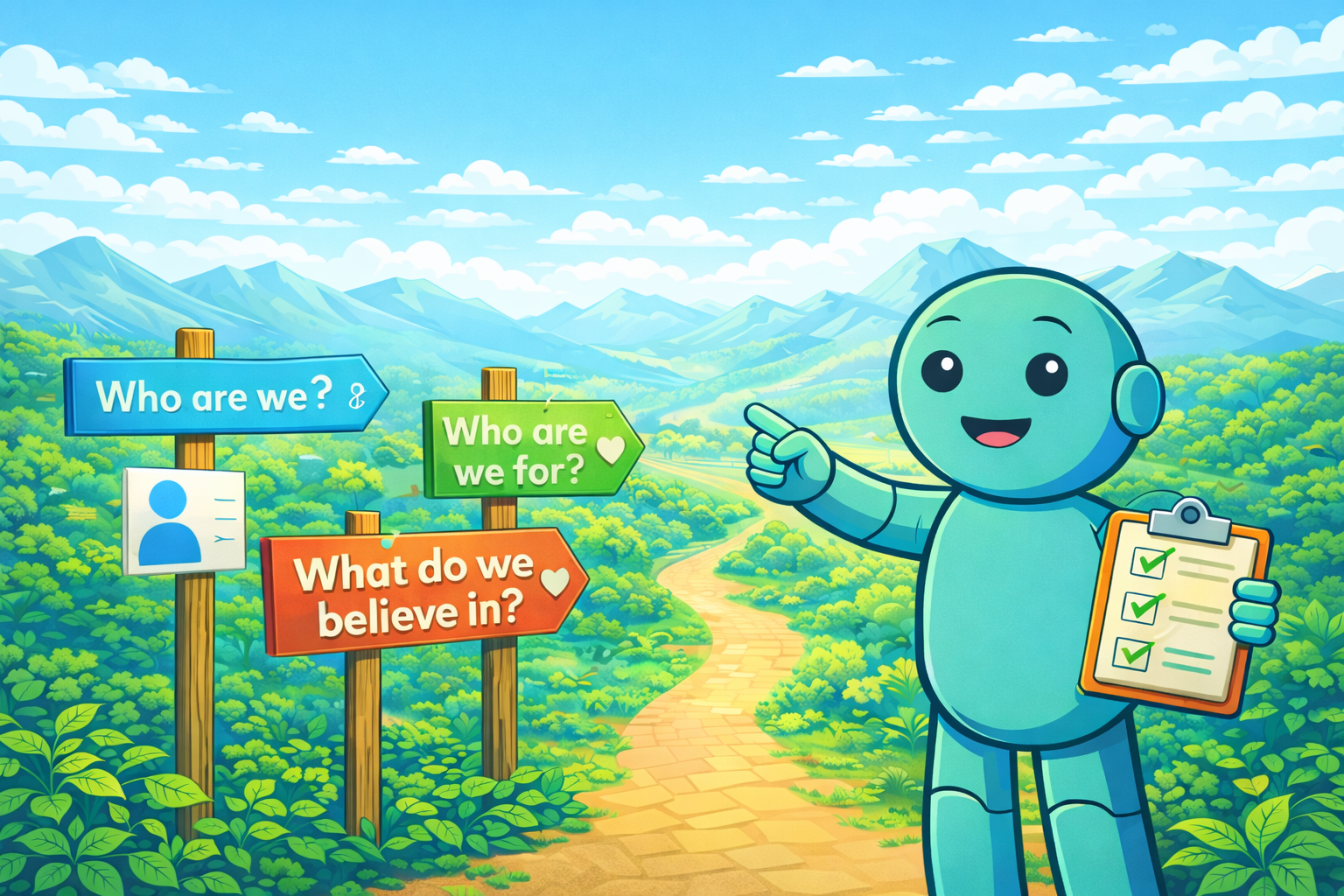
Diving headfirst into a name generator without a brand strategy is like trying to build a house without a blueprint. Sure, you might end up with something that looks cool, but it won't be functional or stand the test of time. Your name is often the very first thing a customer interacts with, so it has to carry the weight of your entire brand story.
A strong name grows directly out of a deep understanding of your brand's core. It becomes a compass that guides every marketing campaign, design choice, and business decision that follows. Taking the time to build this foundation now saves you from the painful realization a year down the road that you've outgrown a name that no longer fits.
Articulate Your Mission and Vision
Your mission is your "why" right now; your vision is where you're headed. Nailing these down gives you the raw material for a name with real purpose and longevity. A name that’s tied to your core values will always feel more authentic and connect on a deeper level.
To get the ball rolling, ask yourself these questions:
- Mission: What specific problem do we solve for our customers every day?
- Vision: What is the ultimate impact we want to have on our industry or the world in 5-10 years?
- Values: What are the three non-negotiable principles that guide how we operate?
Think about it: a mission to "make sustainable products accessible" will spark completely different name ideas than one focused on "providing luxury, handcrafted goods." The first path leads to names that feel green, simple, and community-focused, while the second suggests exclusivity, artistry, and prestige.
Pinpoint Your Ideal Customer
This is a big one. You aren’t naming the company for yourself or your investors; you're naming it for the people you want to serve. A name that clicks with a 22-year-old gamer will almost certainly miss the mark with a 55-year-old C-suite executive. That's why you need to build a detailed picture of your ideal customer.
Go beyond the basic demographics. What do they care about? What are their biggest challenges? What kind of language do they use in their own communities? Your name needs to feel like it belongs in their world. A playful, irreverent name like "Goosepoop Games" is brilliant because it instantly signals to a very specific "lighthearted goofball" audience that they've found their people.
A brand name shouldn't just describe what you do; it should signal to the right people that you are for them. It's a beacon that helps your tribe find you in a crowded marketplace.
Analyze Your Competitors
Scoping out the competition isn't about copying what they're doing - it's about finding a lane they've left open for you. Make a list of your top five competitors and take a hard look at their names.
Break it down by asking:
- Do their names sound modern and techy, or classic and traditional?
- Are they descriptive and literal, or more abstract and evocative?
- What naming trends are common in the industry (e.g., weird spellings, ending in "-ify")?
This analysis helps you spot the patterns so you can intentionally break them. If every competitor has a serious, corporate-sounding name, a more creative and human-centric name could immediately set you apart. On the flip side, if the market is saturated with quirky, made-up words, a straightforward and professional name might communicate trust and stability. The goal is to carve out your own unique space so your name doesn't just fade into the background.
Brainstorming Techniques for Creative Naming
Once you’ve nailed down your brand's foundation, the real creative work begins. This is where you get to play, explore, and generate a massive list of potential names. The aim here isn't to find "the one" right away. Instead, you're building a "longlist" - a diverse pool of raw material that gives you plenty of high-quality options to refine and test later.
So, for now, forget about perfection. Let's focus on getting a ton of ideas down on paper. A bit of structure in your brainstorming will get you much better results than just waiting for that mythical bolt of inspiration.
Sparking Ideas with Word Association and Mind Maps
One of the most reliable and time-tested methods is good old-fashioned word association. Start with a core concept from your brand definition, words like "security," "speed," or "community." Then, just let your mind go and write down every single related word or idea that pops into your head, no matter how wild it seems.
You'd be surprised at the creative avenues this opens up. For example:
- Core Concept: Growth
- Associated Words: Sprout, ascend, elevate, expand, bloom, nexus, summit, origin.
Take this a step further with mind mapping. Put your main brand idea in the center of a page and draw branches out for related themes, like your company values, the feelings you want customers to have, and the benefits of your product. Each of those branches can then sprout smaller sub-branches with specific words. It’s a great visual way to connect different ideas in new and interesting ways.
Digging Deeper with Keywords and Metaphors
It’s easy to get stuck using the same old industry jargon. If you're in finance, words like "capital," "wealth," and "invest" are everywhere. To stand out, you need to deconstruct those terms. Think about the feelings and outcomes they represent. What does financial security actually feel like? Maybe it’s a "haven," an "anchor," or a "keystone."
This is where metaphors really shine. A name like "NestEgg" is brilliant because it instantly communicates security and nurturing for retirement savings without using any dry financial terms. Think about analogies for what your business actually does.
Your name doesn't have to be literal to be effective. The most memorable names are often metaphorical, forging an emotional connection that a descriptive name simply can't match.
Using Name Generators as a Creative Springboard
Don't be afraid to lean on modern tools to get the ball rolling. While I wouldn't count on a generator to spit out your perfect final name, they are fantastic for sparking fresh ideas and shattering creative blocks. They can mash words together, invent new ones, and suggest angles you would never have thought of on your own.
For instance, NameRobot’s own tools let you plug in your core keywords and get back hundreds of suggestions in all sorts of styles, from classic and professional to modern and playful. This is where you can really accelerate the process.
Here’s a look at the variety of generators available in NameRobot, each built for a specific creative task.
The trick is to treat these suggestions as inspiration, not the final product. A generated name might feel 90% wrong, but that last 10% could contain the unique prefix, suffix, or phonetic sound that leads you to your perfect name. To get the most from them, it helps to know what's out there; check out our guide on https://www.namerobot.com/All-about-naming/naming-tools-for-every-need/business-name-generators to find the right tool for your project.
Assembling Your Diverse Longlist
As you work through these exercises, start organizing your ideas into a few key categories. This helps ensure you have genuine variety and gives you different strategic directions to think about later. Your goal should be a healthy, robust list of at least 50-100 names.
Common Name Categories to Explore:
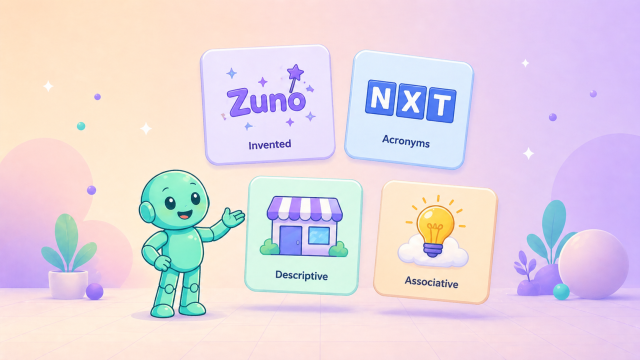
- Descriptive: These names clearly state what the business does (e.g., "General Motors").
- Evocative: These suggest a benefit, a feeling, or an experience (e.g., "Nike," named for the goddess of victory).
- Invented: These are completely new words created just for the brand (e.g., "Kodak," "Xerox").
- Metaphorical: These use a symbol or well-known idea to represent the brand's essence (e.g., "Amazon").
Having options in each category is vital. A descriptive name might feel like the safe choice, but an evocative one could build a much stronger, more emotional brand connection. By exploring all these paths, you give yourself the best possible chance to find a name that’s not just creative, but strategically powerful.
How to Evaluate Your Shortlist of Names
You've gone through the creative whirlwind of brainstorming and now you’re sitting on a long list of potential names. Great. But now comes the hard part, transforming that raw list into a refined shortlist of genuine contenders.
This is where we move from "what sounds cool" to "what actually works." It's a methodical process, but it’s what separates a clever idea from a strong, lasting brand.
This handy visual lays out the journey from a big pool of ideas to a validated shortlist.
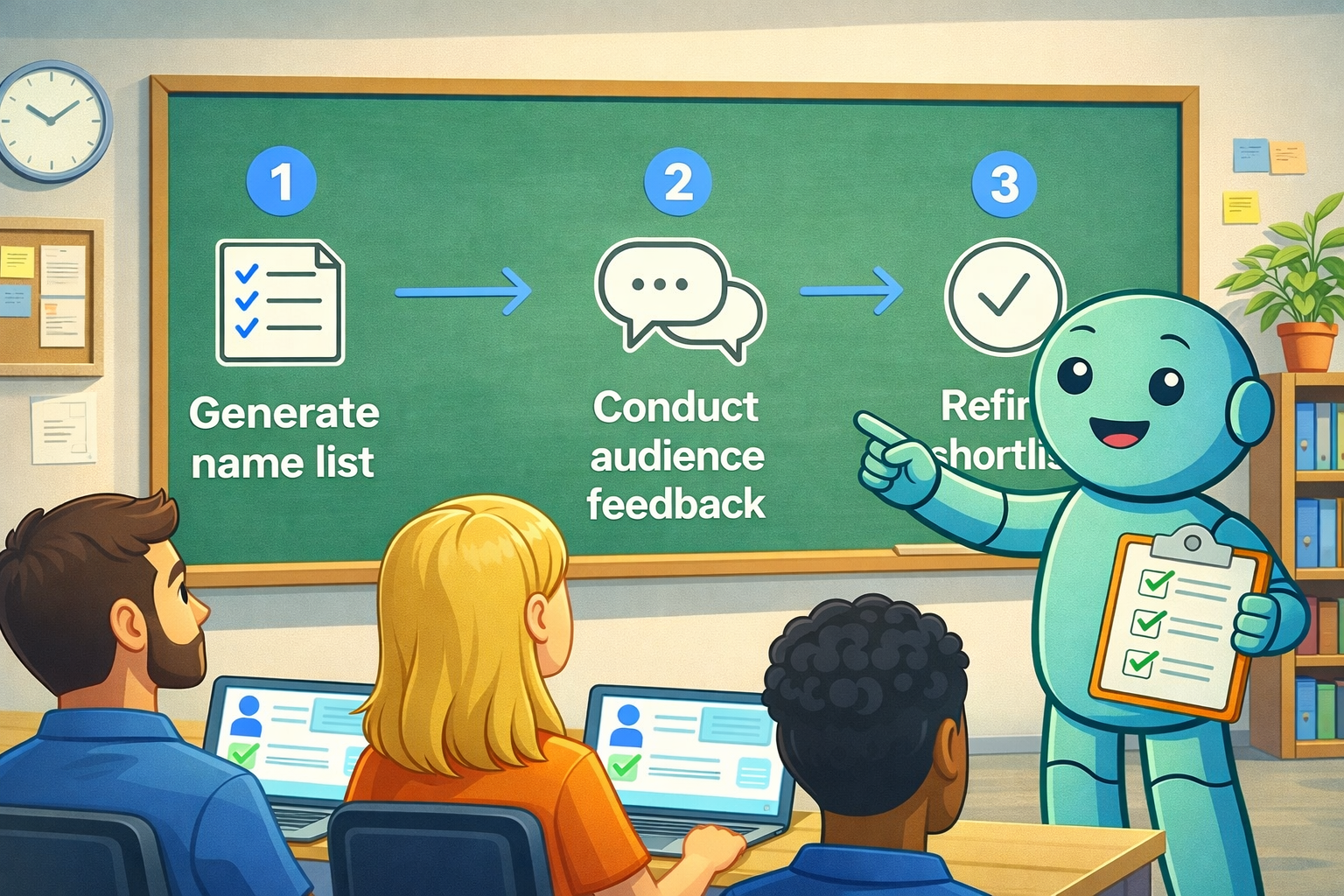
As you can see, it’s a funnel. You start broad, gather feedback, and systematically narrow down your options until only the strongest names remain.
The Spelling and Pronunciation Test
The very first filter every name has to pass is the "say it out loud" test. It’s deceptively simple, but incredibly important.
If you tell someone your company name and they have to ask, "How do you spell that?" - you have a problem. Think about a potential customer hearing your name on a podcast. Can they easily find you on Google, or will they get frustrated and give up? Friction is the enemy.
A real-world example is "Stonemaier Games." It’s a combination of the founders' last names, but the founder himself has admitted it’s a constant hurdle for people to spell and pronounce correctly.
Your name should be an open door, not an obstacle course. Easy spelling and pronunciation mean that word-of-mouth works for you, not against you.
Assessing Memorability and Uniqueness
In a sea of competitors, a generic name is an invisibility cloak. Your name needs to be memorable, it has to stick in someone's mind after just one encounter.
Take "Goosepoop Games," for example. It’s certainly unconventional and highly memorable. The founder says it instantly connects with his target audience of "lighthearted goofballs." While that specific vibe isn't for everyone, it perfectly illustrates the power of a name that stands out and is easy to find online.
As you go through your list, ask yourself these tough questions:
- Does this sound a little too much like my competitors? Be honest.
- Is it easy to remember a day after hearing it for the first time?
- Will a quick search bring me up, or will I be buried under common words?
Checking for Unintended Meanings
This one’s a classic pitfall. A name that sounds perfect in your language could mean something completely different, and often embarrassing, in another. This is non-negotiable if you have any plans for international growth.
Even simple acronyms can create headaches. Imagine a company called "Sunshine Coast Art and Branding." The potential for an awkward acronym is right there. Always check for slang associations, negative connotations, or weird interpretations in other cultures.
Don't forget the visual check, either. Certain letter combinations can look strange or spell out other words when designed into a logo. Write your top names out in a few different fonts to spot any issues before you get too attached.
Developing a Scoring System
To take some of the subjectivity out of this process, I always recommend creating a simple scoring system. It’s a great way to compare your top candidates objectively against the criteria that matter most for your brand.
You can set up a basic scorecard and rate each name from 1 (Poor) to 5 (Excellent) across a few key categories. It forces you to be brutally honest about each name's true strengths and weaknesses.
To make this tangible, here is a simple matrix you can use.
Name Evaluation Scorecard
| Evaluation Criteria | Name Idea 1 | Name Idea 2 | Name Idea 3 |
|---|---|---|---|
| Easy to Spell & Pronounce | |||
| Memorable & Unique | |||
| Aligns with Brand Persona | |||
| Available Domain & Socials | |||
| Positive Connotations | |||
| Total Score |
The name with the highest score isn't automatically the winner, but this exercise will give you incredible clarity on which options are genuinely the most viable.
Remember, your name is your brand's first handshake. And that first impression is everything; research shows that a staggering 73% of consumers form an initial judgment about a brand based on the name alone. That’s why a methodical evaluation isn't just a nice-to-have, it's essential for building a brand that clicks from the very first moment. If you want to dive deeper into how names influence customers, check out these business naming trend insights.
Time for the Essential Legal and Digital Checks
You’ve got a solid list of potential names, and a few are starting to feel right. This is the fun part, but it's also where you need to switch gears from creative brainstorming to serious due diligence. Getting attached to a name before you know it's legally and digitally available is a classic mistake, and it almost always leads to disappointment.
Trust me, this stage is non-negotiable. Skipping these checks is one of the most expensive blunders a new business owner can make. Down the road, it can mean facing a nasty legal battle, a forced rebrand, or losing all the brand equity you’ve worked so hard to build.
Securing Your Digital Real Estate
Before anything else, your first move should be a quick domain and social media search. In today’s world, your digital address is your storefront, and consistency is everything.
Start with the domain. While there are countless extensions out there, the .com is still the undisputed king. It’s what people instinctively type into their browser, and it carries an immediate sense of authority. Head over to a domain registrar like GoDaddy or Squarespace and see if your desired .com is available.
If it’s taken, don’t panic. The next question is: is the site being used by an active business in your industry? If so, that's a huge red flag for brand confusion. But if it's just parked or for sale, you might have the option to buy it, though you should be prepared for a hefty price tag.
Next, jump onto the social media platforms that matter to your audience, whether that’s Instagram, Facebook, X (formerly Twitter), LinkedIn, or TikTok. You’re looking for handle availability. Having @YourBrandName on one platform and @YourBrandNameOfficial123 on another just looks messy and makes you harder for customers to find.
Quick Digital Availability Checklist:
- Primary Domain: Is the
.comavailable? If not, is a good alternative like.coor.ioa fit for your niche? - Social Handles: Are the clean, exact-match usernames available on your core platforms?
- Consistency: Can you lock down a consistent identity across all your digital channels?
Running this quick digital check can often weed out a few names on your shortlist right away, saving you time before you dig into the legal side of things.
Navigating the World of Trademarks
This is, without a doubt, the most critical check you'll perform. A trademark legally protects a word, phrase, or symbol that identifies your business. If you accidentally use a name that infringes on someone else’s registered trademark, you could find yourself on the receiving end of a cease-and-desist letter or, worse, a costly lawsuit.
You can, and should, do a preliminary trademark search yourself. For businesses in the United States, the go-to resource is the U.S. Patent and Trademark Office's (USPTO) TESS (Trademark Electronic Search System) database. You can search for your name to see if another company has already registered a similar mark for a related category of goods or services.
Don't just search for the exact name. You need to think like a lawyer and look for names that sound the same or have a similar meaning. The legal standard is "likelihood of confusion," which is a pretty broad net.
This initial search is your first line of defense. If another software company already owns a trademark for a name that sounds just like yours, it’s a clear sign to walk away and move on to the next name on your list. For a deeper dive, you can learn more about how to verify the availability of company names and start protecting your brand from day one.
Why You Absolutely Must Talk to a Lawyer
While a DIY search is a great start, let me be clear: it is not a substitute for professional legal advice. Trademark law is incredibly complex, filled with nuances that a simple online search will never uncover. This is not the place to cut corners to save a few hundred dollars.
An experienced trademark attorney will perform a comprehensive search that goes far beyond the federal database. They’ll dig into state-level trademarks and "common law" usages, unregistered marks that can still hold legal rights. Most importantly, they can interpret the results and give you a clear assessment of your risk.
Think of it this way: the cost of hiring an attorney to clear your name is a tiny investment compared to the astronomical cost of rebranding your entire company a year or two from now. It’s a foundational investment in your brand's future, ensuring the name you build is truly yours to keep.
Making the Final Choice and Securing Your Name
You've made it through the brainstorming, the shortlisting, and the crucial legal checks. Now you're left with a handful of names, each one a potential future for your brand. This is where the process shifts from objective analysis to real-world validation. It’s time to make that final, confident choice.
It's easy to feel a little paralyzed at this stage. To get over that hump, you need to hear how your top contenders actually sound out in the wild, far from the echo chamber of your own team.
Gathering Unbiased Feedback
Getting outside opinions is a must, but there’s a right way and a wrong way to do it. Simply asking friends and family, "Which one do you like best?" will get you polite, but ultimately useless, feedback. What you really need is honest input from people who actually fit your ideal customer profile.
A surprisingly effective method is to run a small, anonymous survey. Present your top three names without any branding or context and ask questions that dig into gut reactions:
- Which of these names is the most memorable?
- What kind of product or service do you think this company offers?
- Which name sounds the most trustworthy to you?
This little trick sidesteps personal bias and gives you raw data on first impressions. It moves the conversation away from "what I like" to "what the market perceives," which is infinitely more valuable when figuring out how to name my company.
Test Drive Your Finalists
Before you commit, take your top one or two names for a spin. This means working them into everyday situations to see how they feel.
Try introducing yourself in a mock scenario: "Hi, I'm the founder of [Company Name]." Does it roll off the tongue, or do you stumble over it? Call up a friend and say it over the phone. Do they immediately ask you to spell it out? These simple, practical tests can uncover usability issues you’d never spot on a spreadsheet.
A name that looks great on paper might feel completely unnatural in conversation. The goal is to find a name that is as effortless to say as it is to read, ensuring it works in every context, from a pitch meeting to a podcast interview.
Another pro tip is to create quick-and-dirty logo mockups for your finalists. You don't need a designer for this; a tool like Canva is more than enough. Seeing your name in a visual context, on a website header, a business card, or a social media profile, can be a real lightbulb moment.
Lock It Down Immediately
Once you’ve landed on the one, the time for deliberation is over. You have to move fast to secure your brand’s digital and legal footprint before someone else beats you to it.
Treat this as a time-sensitive, all-hands-on-deck moment. Here’s your checklist:
- Register the Domain Name: Head straight to your preferred registrar and buy the .com domain. Don't wait. Even if you aren't building the site today, you need to own that digital real estate.
- Secure Social Media Handles: Create accounts on every platform that matters for your brand. Snagging the clean, exact-match handle is crucial for brand consistency.
- Begin Formal Registration: Kick off the process of registering your business name legally, whether that’s an LLC, a sole proprietorship, or a corporation, based on your local regulations.
- File for a Trademark: This is the big one. Get in touch with a trademark attorney and start the filing process to gain the ultimate legal protection for your brand identity.
This final flurry of activity is where your brand stops being an idea and becomes a real, tangible asset. Remember, 81% of consumers say they need to trust a brand before buying from them, and your name is the first step in building that trust. With 77% of consumers preferring brands they follow on social media, securing a consistent, professional name everywhere is non-negotiable.
Common Questions That Come Up When Naming a Company
Even when you follow a solid process for naming your company, you're bound to hit a few roadblocks. Certain questions always seem to pop up, and getting tripped up by them is totally normal. Let's walk through some of the most common ones I hear from founders.
Getting these sorted out is key to keeping your momentum going, especially when you feel like you're close to a final decision.
Should I Just Use My Own Name for the Business?
This is a classic move, and it makes perfect sense for certain businesses. If you're a consultant, a designer, or a professional whose reputation is the brand, using your own name can be a shortcut to building trust. Think of a law firm or a design agency where the founder’s name is a stamp of quality.
But it’s not without its drawbacks. A business tied directly to your name can be tough to sell down the line. It also makes it harder to build a brand that feels bigger than just one person. And honestly, it can sometimes lack the creative flair needed to pop in a busy marketplace.
Here's my advice: Think about your long-term goals. If you envision a company that can one day operate and grow without you at the helm, you're almost always better off with a distinct brand name.
What if the .com Domain Is Already Taken?
That feeling when you find the perfect name, only to see the .com is gone... it’s a gut punch. But don't give up just yet. Your first move should be to see how the domain is being used. If it’s an active business in your field, you have to drop the name. It’s a non-starter due to brand confusion and potential legal headaches.
If the domain is just sitting there, parked or for sale, you’ve got options. You could try to buy it, but be prepared for a potentially hefty price tag. Or, you can get creative:
- Tack on a verb: Think like
GetDropbox.comorTryCaviar.com. It’s a common and effective workaround. - Explore other TLDs: Extensions like
.coand.ioare widely accepted in the tech world. A.shopor.storeworks well for e-commerce. Just be aware that many people will still type.comout of habit. - Tweak the name itself: Sometimes a small, smart adjustment to the name can free up an available
.comwithout losing the original magic.
How Much Does It Really Cost to Trademark a Name?
Trademarking is an investment, but it's one of the most important ones you'll make for your brand. The filing fees with the United States Patent and Trademark Office (USPTO) aren't too bad, usually landing somewhere between 750 per class of goods or services.
But that's just the government fee. I strongly recommend hiring a trademark attorney. Yes, it adds to the cost, but their ability to conduct a proper search and handle the application is worth every penny. They know how to spot potential conflicts you’d never see, saving you from a costly rejection or a much more expensive legal battle later. It's brand insurance, plain and simple.
Is It Cheating to Use an AI Name Generator?
Not at all. In fact, I think they’re a fantastic way to get past a creative block. An AI tool can spit out hundreds of ideas in minutes, mashing up words and concepts in ways your brain might not naturally go.
The trick is to use these tools as a starting point, not a final destination. Think of the suggestions as raw clay. Take the ones you like and run them through your full vetting process, check if they’re memorable, if they fit your brand, and most importantly, if they’re legally available. It’s about finding a name that’s not just clever, but a smart, strategic choice for your business.
Ready to stop wondering and start finding? NameRobot offers a complete toolkit to take you from brainstorming with AI to running instant trademark checks. It's built to guide you through every step. Find your perfect, market-ready name today at https://namerobot.com.