What Makes a Good Business Name & How to Create One
What makes a good business name? It’s not just about sounding clever. It’s a careful mix of art and science, finding something that’s memorable, meaningful, and actually available to claim online.
Want to turn this into real name ideas? Open Naming Toolbox to generate, refine, and compare naming options while you read.
Think of it this way: your business name is your first handshake. Before anyone knows what you sell or why you’re great, they hear your name. It needs to be firm, confident, and unforgettable, setting the stage for everything that comes next.
Your Business Name Is Your First Handshake
Long before a customer sees your product, reads your mission statement, or experiences your service, they meet your name. This isn't just a label; it’s a strategic asset that starts shaping perception from the very first moment.
In a marketplace overflowing with options, that first impression is made in a fraction of a second. A strong name does the work for you, acting as a silent brand ambassador. It’s the difference between being instantly understood and being instantly forgotten.
Your business name isn’t just what you’re called, it’s the first chapter of your brand story. It’s the hook that draws people in, creating a foundation of trust and curiosity before they even know what you do.
The right name telegraphs confidence, hints at your value, and makes your brand feel professional right out of the gate. On the flip side, a weak or confusing name creates friction. It makes it harder for customers to remember you, find you online, or tell their friends about you. That initial perception is incredibly powerful.
The Power of a First Impression
The impact of a name isn’t just a gut feeling; consumer behavior backs it up. Attention is the most valuable currency we have, and in a fast-scrolling world, your name has to do some heavy lifting. It needs to be compelling enough to stop a thumb and spark a flicker of interest.
Here’s why it matters so much: a staggering 73% of consumers form their initial perception of a brand based on its name alone. This statistic really drives home how a strong name is crucial for grabbing attention and building immediate trust. You can dive deeper into how top brands are shaping their identities and explore current business naming trends.
A well-chosen name aligns with your brand's soul and speaks directly to your ideal customer. It can suggest quality, innovation, or friendliness, all in just a few syllables.
Before we go deeper, here’s a quick summary of the core attributes we’ll be exploring.
Core Attributes of a Powerful Business Name
This table provides a quick-reference summary of the essential traits that define an effective business name, setting the stage for the concepts explored in this guide.
| Characteristic | Why It Matters | Example |
|---|---|---|
| Memorable | If customers can't recall your name, they can't find you or refer you. Simplicity and rhythm are key. | Slack |
| Relevant | The name should give a clue about what your business does or the feeling it evokes. | Whole Foods |
| Distinctive | It needs to stand out from competitors to avoid confusion and carve out its own space in the market. | Warby Parker |
| Available | The name must be legally available and have a corresponding domain name that you can own. | Zoom |
| Future-Proof | A good name won't pigeonhole your business, allowing for growth and expansion into new areas. | Amazon |
These attributes don't work in isolation; the best names manage to check several of these boxes at once.
A great name has to perform a few core functions effortlessly:
- It sets expectations: A name like "Precision Auto Care" immediately creates a different expectation than "Speedy Lube." One promises meticulous work, the other promises speed.
- It aids memorability: Simple, catchy names are just easier to recall and share. This is the fuel for word-of-mouth marketing.
- It builds an emotional connection: Names like Patagonia or Allbirds evoke a feeling and a lifestyle, not just a product.
Ultimately, what makes a good business name is its ability to do all of this without you saying a word. It’s the invisible engine that drives brand recognition and customer loyalty from day one.
The Seven Pillars of an Unforgettable Name
Knowing the theory behind a great name is one thing. Turning that theory into a practical tool you can actually use to test your ideas? That’s the real goal. A powerful business name isn't built on a single quality; it's a careful blend of several key characteristics working in harmony.
These are the seven pillars that hold up a memorable, effective, and lasting brand identity. Think of this as your checklist, a way to pressure-test your name ideas and see if they have what it takes for the long haul. A name that stands firm on all seven of these pillars is a name that's built to last.
This simple diagram breaks down the three most crucial pillars, Memorability, Relevance, and Uniqueness, that form the foundation of any killer business name.
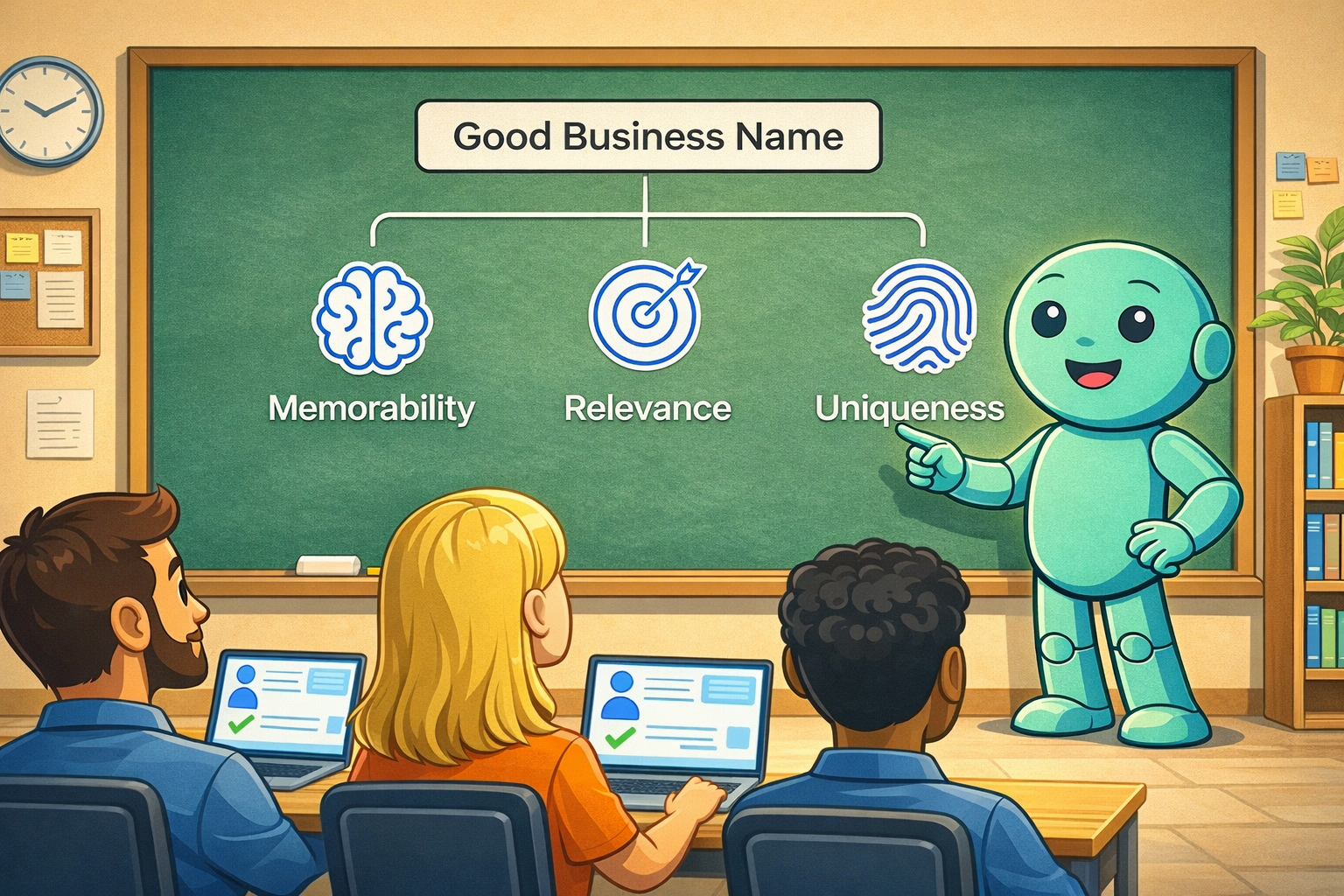
As you can see, while lots of factors are in play, a name has to first be easy to remember, hint at what you do, and stand out from the crowd. Get these three right, and you've got a fighting chance.
Pillar 1: Memorability and Pronounceability
If customers can't remember your name, they can't recommend you. It's that simple. Memorability is the bedrock of word-of-mouth marketing. The best names often feel simple, have a nice rhythm, and stick in your head after hearing them just once. Think of how easily names like Google, Slack, or Nike roll off the tongue.
Right alongside this is pronounceability. If people stumble over saying your name, they’ll be hesitant to share it. A great way to test this is the classic "radio test": could someone hear your name on a podcast or radio ad and easily know how to spell it when they search for you online? Awkward spellings and weird pronunciations just create friction you don't need.
A name that is both easy to recall and simple to say has a huge head start. It travels faster, spreads more organically, and makes it that much easier for customers to become your biggest fans.
Pillar 2: Relevance to Your Brand
Your name doesn't need to be a boring, literal description of your business, but it should feel right for your industry and hint at the value you bring. It needs to align with the entire vibe and promise of your brand. A name like Whole Foods instantly brings to mind health, natural products, and a massive selection.
But this doesn't mean you have to be literal. An evocative name like Patagonia doesn't explicitly mention outdoor gear, but it conjures powerful images of adventure, rugged landscapes, and exploration, a perfect match for its brand ethos.
A relevant name acts as a shortcut. It helps customers instantly categorize your business in their minds, setting the right expectations and attracting the right audience from the very beginning.
Think about the emotional connection your name creates. Does it sound innovative, trustworthy, playful, or luxurious? The name's tone should be a perfect match for the brand experience you're building.
Pillar 3: Uniqueness and Distinction
Your name’s job is to set you apart, not help you blend in. In a crowded marketplace, a generic or derivative name is basically an invisibility cloak. A unique name, on the other hand, carves out its own space and prevents your customers from getting you mixed up with someone else.
This is where thorough competitor research is an absolute must. If you're launching a tech startup, a name ending in "-ify" or "-ly" might seem trendy, but it could easily get lost in a sea of sound-alikes. The goal is to be distinct enough to own your name in the customer’s mind. For instance, Warby Parker entered a very established eyewear market with a name that felt fresh, quirky, and totally different.
Pillar 4: Timelessness and Durability
Trends die. And a name that's tied too closely to a fleeting fad will sound dated almost overnight. A truly great name is built for the long run. Steer clear of names that lean on specific technologies or slang terms that might be obsolete in five years.
Consider your long-term vision. Will this name still make sense in a decade? Or two? A name like Amazon, suggesting vastness and scale, has proven far more durable than something like "Online Books," which would have been incredibly limiting.
Pillar 5: Scalability for Future Growth
One of the most common naming mistakes is picking a name that's too narrow, effectively pigeonholing your business from day one. If you call yourself "Austin Web Design," what happens when you want to expand to Dallas or start offering branding services?
Your name should be broad enough to allow for future growth, new products, and different markets. This is why so many successful brands choose evocative or even abstract names.
- Apple started with computers, but the name was flexible enough to expand seamlessly into phones, music, and watches without missing a beat.
- Virgin grew from a record label into a massive empire spanning airlines, mobile phones, and even space travel, all under a single, versatile brand name.
Pillar 6: Digital Friendliness
In today’s world, a name isn’t really yours until you own the digital real estate that comes with it. This isn't just a suggestion; it's a non-negotiable step in the process.
The holy grail is securing the .com domain for your business name. If it’s taken, you can explore slight variations, but a clean .com is still the gold standard for credibility. You also have to check for social media handle availability on the platforms that matter to your audience. A consistent name across all your digital channels is critical for building a strong, cohesive brand.
Pillar 7: Legal Availability
Finally, and most importantly, your name must be legally yours to use. This means it can't infringe on an existing trademark. Using a name that’s already trademarked, even if by accident, can land you in a world of expensive legal trouble and force a painful rebranding down the road. Before you fall in love with any name, a thorough trademark search is an absolute must.
Choosing Your Strategic Naming Style
Knowing the ingredients of a great name is one thing. The next step is deciding on the recipe, your strategic direction. Not all names are created equal because they aren't all designed to do the same job. The approach you choose has to be a deliberate decision, one that reflects your brand’s personality, your place in the market, and where you see yourself in the long run.
Think of naming styles like different kinds of vehicles. A sturdy delivery truck is all about function; it’s practical and gets the job done directly. A sleek sports car, on the other hand, is built to create an emotional experience. Both can get you to your destination, but they do it in completely different ways and send wildly different messages about who you are.
Your business name functions in precisely the same way. The style you land on, whether it's direct and descriptive or abstract and evocative, sets the entire tone for how customers perceive you, long before they ever interact with your products or services.
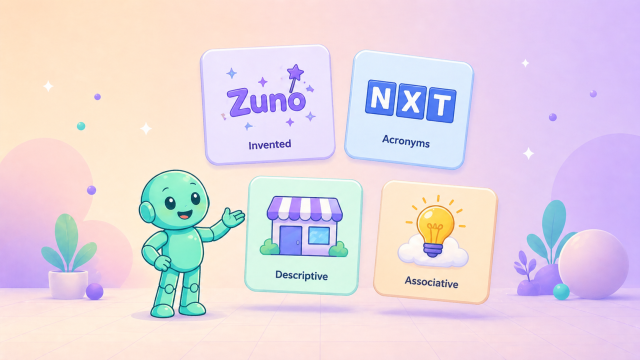
Let's break down the four primary naming styles to help you find the right fit for the road ahead.
Descriptive Names: The Straight Shooters
Descriptive names are the most straightforward of the bunch. They tell people exactly what your business does, leaving very little to the imagination. That kind of clarity can be a massive advantage, especially if you have a limited marketing budget and need to communicate your value in an instant.
Names like The Weather Channel or Hotels.com are incredibly effective precisely because they are functional. They practically own their keywords in search engines and require almost no explanation.
- Pros: Immediately clear, fantastic for SEO, builds trust through transparency.
- Cons: Can come off as generic, are often difficult to trademark, and might box you in if your business pivots or expands into new areas.
This style is a perfect match for local services or niche online tools where function trumps flair. It’s the "what you see is what you get" of the naming world.
Evocative Names: The Storytellers
Instead of describing what a business does, evocative names suggest a feeling, a benefit, or a bigger idea. They tap into emotion and imagination to start building a powerful brand story from day one. Think of Nike, named for the Greek goddess of victory, or Patagonia, which immediately conjures images of rugged, untamed adventure.
These names are powerful because they help build a brand that’s about more than just a product; they create a lifestyle and a true sense of belonging. This style definitely requires a bigger marketing investment to forge the link between the name and the business, but the payoff can be incredible brand loyalty.
An evocative name is a blank canvas. It gives you the creative freedom to build a rich brand narrative around it, connecting with customers on a much deeper, more emotional level than a simple description ever could.
This approach is ideal for consumer brands, lifestyle companies, and any business that wants to forge a strong emotional bond with its audience. It has the power to turn a simple product into an unforgettable experience.
Invented Names: The Trailblazers
Invented (or abstract) names are completely new words, coined just for the brand. Names like Kodak, Google, or Venmo simply didn't exist before their companies came along. This makes them highly distinctive and, as you might guess, much easier to trademark. Their uniqueness makes them stick in our minds.
The biggest hurdle? An invented name has no built-in meaning. You have to put in serious time and money to teach your audience what it stands for. It's a high-risk, high-reward strategy that demands confidence and a rock-solid marketing plan to turn an invented word into a household name.
The journey from a specific service like a search engine to a global tech behemoth often requires a name that can grow with you. To see how the pros handle this, you can discover more about the strategic thinking behind major tech rebrands and learn from Google's decision to become Alphabet in our detailed analysis.
Acronyms: The Insiders
Acronyms are names formed from the initials of a longer, more descriptive name, think IBM (International Business Machines) or CVS (Consumer Value Stores). Historically, many companies shifted to an acronym after their full name became too long or cumbersome for modern branding.
While they are short and can be easy to recall once established, acronyms often feel cold, impersonal, and a bit corporate. For a brand-new business, starting out with an acronym is a tough hill to climb because it lacks any inherent meaning or emotional hook. They tend to work best for established B2B companies or organizations where a formal, buttoned-up tone is actually an asset.
A word of caution here: Before you commit to an acronym, double- and triple-check that the letters don't spell out something embarrassing or unintentional. That one simple check can save you from a massive branding headache down the road.
How a Great Name Becomes a Financial Asset

It’s easy to think of naming your business as a purely creative task, but in reality, it's one of the first and most important financial decisions a founder makes. A great name isn't just a label; it’s a hard-working asset that appreciates over time, directly boosting your bottom line. It’s the difference between building your brand on solid ground versus shifting sand.
Think of it like laying the foundation for a house. A strong, well-poured foundation can support the entire structure for decades, allowing you to build upward with confidence and adding to the property's value. A weak foundation, on the other hand, causes endless problems, cracks in the walls, crooked floors, and expensive repairs that drain your resources. A strategic name works the same way; it supports growth, while a poor one becomes a constant, costly burden.
Building Tangible Brand Equity
Your business name is the primary container for your brand equity, that invaluable mix of reputation, customer perception, and market presence. When people have a good experience with your company, all those positive feelings get attached directly to your name. Over time, that name comes to stand for something real: trust, quality, and reliability.
This isn't just some fuzzy marketing concept; it has real financial weight. A brand with high equity can:
- Command higher prices: People will happily pay a premium for a name they trust. Apple doesn’t just sell electronics; it sells the innovation and status attached to the Apple name.
- Create fierce loyalty: A strong name builds an emotional bond, turning one-time customers into advocates who stick around, even when competitors are cheaper.
- Attract the best talent: A respected name makes it easier to recruit top-tier employees who are eager to be part of a winning brand.
The right name is more than a marketing tool, it’s a capital investment. Every dollar you spend on advertising enhances the value of a strong name. A weak name just consumes those same dollars trying to overcome its own flaws.
This long-term value is essential for staying relevant. Consider this: Interbrand's analysis of the top global brands since 2000 shows that 85 of the 185 brands ranked have since fallen off the list. Many disappeared because they failed to maintain a powerful, relevant brand identity, proving just how much a strong name matters for endurance.
Reducing Costs and Maximizing ROI
Beyond building value, a great name is also a powerful cost-cutting tool. If your name is memorable, relevant, and unique, it naturally requires less marketing spend to get noticed. It’s easier for people to remember, easier to find online, and easier to share through word-of-mouth, all of which gives you a huge head start.
On the flip side, a generic, confusing, or hard-to-spell name forces you to overspend on marketing just to make an impression. You’re constantly fighting an uphill battle against obscurity, with your budget going toward fixing a foundational problem instead of building momentum.
Short-Term Savings vs Long-Term Value in Business Naming
Many founders fall into the trap of rushing the naming process to save time or money upfront, but this almost always leads to bigger costs down the road. This table breaks down the difference between a hasty decision and a strategic one.
| Decision Point | Short-Term Approach (and its Cost) | Strategic Approach (and its Value) |
|---|---|---|
| Initial Investment | Picking a "good enough" name in a day. Cost: Missed opportunity, potential for future rebranding expenses. | Investing weeks in research, brainstorming, and validation. Value: A durable asset that builds equity from day one. |
| Marketing Spend | Higher ad spend needed to explain a confusing name or outrank competitors. Cost: Wasted marketing budget. | A memorable name requires less ad spend for recall and achieves organic reach faster. Value: Higher marketing ROI. |
| Domain & Socials | Settling for a convoluted URL or mismatched social handles. Cost: Customer confusion, lost traffic. | Securing a clean, matching .com domain and social handles. Value: Professionalism and a seamless brand experience. |
| Legal Protection | Choosing a name without a trademark search. Cost: Cease-and-desist letters, forced rebranding, legal fees. | Conducting a thorough trademark check and securing legal rights. Value: Long-term brand security and peace of mind. |
Ultimately, investing time and thought into your name from day one is one of the highest-ROI activities you can undertake. It’s an investment that pays dividends for years, long after the initial effort is forgotten.
Winning in the Digital World with Your Name
These days, your business name doesn't just hang over a door, its main home is online. A name that sounds brilliant in a meeting but is impossible to find or confusing on the web is a major handicap. Its digital-friendliness isn't just a nice-to-have; it's the key that unlocks your entire online presence.
This means you have to look at every single name idea through a digital-first lens. Before you get too attached, you need to be absolutely sure you can claim the online real estate that will become your brand’s home base.
Securing Your Digital Territory
The first, and most critical, step is checking for the domain name. The .com extension is still the gold standard for credibility and memorability. Sure, other extensions exist, but a clean, matching .com is what customers instinctively type and what search engines often prefer.
Once you’ve got your domain sorted, head straight to social media. Check if your desired handle is available on all the platforms your audience uses, like Instagram, X (formerly Twitter), Facebook, and LinkedIn. Consistency here is everything. Having the same handle across the board makes you easy to find and cements your brand identity.
- Domain Name: Is the .com version of your name available? If not, are there simple, intuitive alternatives that won't cause confusion?
- Social Media Handles: Can you get the exact name, or a close and professional-looking variation, on your target platforms?
- Search Engine Results: What pops up when you Google the name? The last thing you want is to compete with a huge brand, a negative news story, or a bunch of ambiguous search results.
Optimizing for Search and Discovery
Beyond just being available, a great business name is easy for search engines, and people, to handle. It should be something customers can type into a search bar without second-guessing the spelling. If your name is overly complex or uses a creative but confusing spelling, you're just making it harder for people to find you.
Think of it like the "radio test." If someone heard your name on a podcast, could they easily find you online? A name that's simple to say and spell has a massive head start in organic search. For those looking for more creative yet practical ideas, our guide on how to find project names and software versions offers some great starting points.
Your name is more than a label; it’s a critical piece of your online marketing. A search-friendly name removes friction, making it easier for customers to discover, remember, and recommend you.
This digital-first thinking is essential because your online reputation depends on people being able to find you. As of 2023, a staggering 85% of consumers trust online reviews as much as a personal recommendation. If they can't find you, you lose the chance to build that vital social proof. You can find more data about how brand storytelling impacts value and consumer trust on linearity.io.
Ultimately, a name that works online is one that is clear, consistent, and easy to locate. It smooths the path for a stronger brand connection, helps you stand out in a crowded market, and ensures that when customers come looking, they find you, not your competitor.
Common Naming Mistakes You Must Avoid
Watching others stumble can save you years of headaches and a small fortune in rebranding costs. Knowing what makes a business name great also means knowing what makes one flop. Honestly, avoiding these common pitfalls is just as crucial as dreaming up creative ideas.
Think of each mistake as a cautionary tale. Understanding these traps from the get-go gives you the foresight to make a solid, strategic choice that will serve you for years to come.
The Radio Test Failure
Picture this: someone hears your company's name on a podcast ad while they're driving. Can they pull over and easily type it into Google? Or are they left scratching their head, trying to guess the spelling? This is the "radio test," and it's where a lot of clever names crash and burn.
Names with quirky spellings (think swapping an "s" for a "z"), silent letters, or homophones just create friction. You're making potential customers work overtime simply to find you, which is never a good thing. The strongest names are intuitive and pass this test without a second thought.
Being Too Generic or Descriptive
Clarity is good, but a name that's overly literal can act like an invisibility cloak for your brand. "Quality Computer Repair" tells people what you do, but it's completely forgettable and blends into the background. Worse, it’s nearly impossible to trademark because you’re using common, descriptive words.
A great name needs a little personality to stick. Instead of just stating your service, try to evoke the feeling or benefit you deliver. That subtle shift is what separates a forgettable label from a genuine brand.
A name that’s too narrow can box your brand in. If "Austin’s Best Cupcakes" ever wants to sell pies or expand to Dallas, that name suddenly becomes a major liability, forcing a confusing and expensive rebrand.
Overlooking Unintended Meanings
Sometimes, a name that looks perfect on paper has a hidden dark side, from an awkward acronym to a terrible translation in another language. Before you fall in love with a name, say it out loud. Write it down. Google it. Does the acronym spell something you’d rather it didn’t? Does the word mean something unfortunate in a market you might expand to one day?
These checks are absolutely essential. A simple oversight can balloon into a PR nightmare that was entirely avoidable. While brainstorming is the fun part, and tools like business name generators can give you a great starting list, the real work is in the vetting. That’s what protects your brand’s future.
Got Questions About Naming? We've Got Answers.
As you get closer to picking a final name, a few practical questions always seem to pop up. Let's tackle some of the most common ones that entrepreneurs run into, clearing up any last-minute doubts so you can finalize your choice with confidence.
How Do I Check If a Business Name Is Taken?
You need to attack this from two angles: the legal side and the digital side. A great name isn't truly great until you know you can own it everywhere that matters.
First, cover your legal bases. Head to your state's Secretary of State website and do a business name search to see if any other company is registered with your chosen name. After that, you'll want to conduct a federal trademark search on the USPTO's TESS database to steer clear of any infringement issues.
Then, it's time to check its digital footprint. A comprehensive web search is a must. See if the domain name is available, the .com version is still king, and look up the name on all the major social media platforms. Securing consistent handles across the board is crucial for building a clean, professional brand.
Should My Business Name Describe What I Do?
It's a classic question, and the answer is: it depends. A descriptive name can be a shortcut to understanding, but it can also be a box you can't get out of later.
A name like "General Motors" tells you exactly what the company does. It's direct and leaves no room for confusion. The downside? It can feel a bit restrictive if you ever want to branch out into, say, flying cars or energy solutions.
On the other hand, an evocative name like "Apple" for computers gives you incredible flexibility to grow. But that flexibility comes at a cost, it takes a bigger marketing budget to teach people what "Apple" means in the context of technology. The right choice really hinges on your long-term goals, your industry, and how much you're willing to invest in brand building.
The right name isn't just about what you do today, but who you want to become tomorrow. Choose a name that gives your brand room to grow, evolve, and surprise your audience.
What Is the Best Way to Brainstorm Name Ideas?
A good brainstorming session is more structured than just throwing words at a wall. It’s about using different techniques to generate a massive list of possibilities before you start cutting them down. Start with your foundation: what's your brand's mission, who are you talking to, and what do you stand for?
Once you have that, get creative with your tools. Use mind maps to connect ideas, a thesaurus to find interesting synonyms, or even dip into foreign language dictionaries for inspiration. Try a few different approaches:
- Mash things up: Combine root words to create something totally new.
- Think in metaphors: What abstract ideas represent the benefit you provide?
- Build compound words: Two simple words can become one memorable name.
The key is to bring in a few different people to get fresh perspectives. The goal is quantity over quality at first. Generate a long, messy list, and then start filtering it through the lens of what makes a name great: Is it memorable? Is it relevant? And, most importantly, is it available?
Ready to find a name that’s not just creative but also market-ready? The NameRobot platform offers a powerful suite of tools, from smart name generators to instant trademark checks, transforming your naming process from a challenge into an inspiring journey. Find your perfect business name with NameRobot today!