Top 5 Competitive Advantage Examples to Win Markets in 2026
In a crowded market, simply having a good product is not enough. Lasting success is built on a durable competitive advantage, the unique edge that allows a company to outperform its rivals consistently over time. This is the core attribute that separates market leaders from the rest of the pack, making their position difficult to challenge and their profitability more secure.
Want to turn this into real name ideas? Open Naming Toolbox to generate, refine, and compare naming options while you read.
But what does this look like in practice? It's more than just a lower price or a clever marketing campaign; it's a deeply embedded strength that is difficult for competitors to replicate. True competitive advantages are strategic, systemic, and sustainable. They are the reason customers choose one brand over another, again and again, even when alternatives are readily available.
This article moves beyond abstract theories to dissect real-world competitive advantage examples. We will explore eight distinct types of market-dominating strengths, from cost leadership and brand loyalty to network effects and proprietary technology. For each example, we will break down the specific strategies, operational tactics, and key decisions that built these powerful positions. You will learn not just what these companies did, but also gain actionable insights into how you can adapt and apply these powerful principles to build your own sustainable edge. We'll examine the "how" behind the "what," offering a blueprint for creating a meaningful and lasting advantage in your own field.
1. Cost Leadership
Cost leadership is a powerful competitive advantage where a company becomes the lowest-cost producer in its industry. This strategy does not mean offering the lowest quality; rather, it involves meticulously engineering every aspect of the business, from supply chain to operations, to reduce costs while maintaining an acceptable quality standard. This efficiency allows the company to either undercut competitors on price, capturing more market share, or to sell at the market price and enjoy a higher profit margin than rivals.

This approach, famously championed by strategists like Michael Porter, is one of the most direct and effective competitive advantage examples when executed correctly. It hinges on achieving significant economies of scale, proprietary technology, or preferential access to raw materials.
Strategic Breakdown: How Cost Leaders Win
A classic example is Walmart. Its cost leadership stems from a sophisticated, technology-driven supply chain, massive bulk purchasing power that pressures suppliers for lower prices, and a hyper-efficient logistics network. Similarly, IKEA achieves its cost advantage through a unique business model:
- Product Design: Furniture is designed from the start for flat-packing, drastically reducing shipping and storage costs.
- Customer Involvement: The self-assembly model outsources the final labor to the customer, saving the company immense operational expenses.
- Operational Efficiency: Large, out-of-town warehouse stores minimize real estate costs while maximizing inventory space.
Actionable Takeaways for Your Business
To build a cost leadership advantage, a business must commit to operational excellence and continuous improvement.
- Optimize Your Value Chain: Systematically analyze every step from sourcing to sales to identify and eliminate unnecessary costs.
- Leverage Technology: Invest in automation and software to streamline processes, reduce labor costs, and minimize human error.
- Negotiate Aggressively: Use volume and long-term contracts to secure the best possible rates from suppliers.
- Standardize Processes: Create replicable, efficient workflows to ensure consistent quality and low operational costs at scale.
This strategy requires a deep understanding of your operational landscape and competitor cost structures. For those looking to delve deeper into strategic positioning, you can learn more about how competitive analysis frameworks can inform your cost leadership strategy.
2. Product Differentiation
Product differentiation is a competitive strategy where a company distinguishes its products or services from rivals' offerings. This distinction can be based on superior quality, innovative features, unique design, or an exceptional brand image. The goal is to create something that customers perceive as unique and valuable, justifying a premium price and fostering strong brand loyalty that insulates the company from price-based competition.

Unlike cost leadership, which competes on price, differentiation competes on value. This approach is one of the most compelling competitive advantage examples because it creates a "moat" around the business built on customer perception and loyalty, not just operational efficiency. Success hinges on a deep understanding of customer needs and a relentless pursuit of innovation.
Strategic Breakdown: How Differentiators Win
A quintessential example is Apple. Its products command a premium not just for their hardware specifications but for their distinctive design, intuitive user experience (iOS), and seamless ecosystem integration. Similarly, Dyson has built an empire by reimagining mundane household appliances:
- Technological Innovation: Dyson invested heavily in R&D to create cyclonic vacuum technology and bladeless fans, solving problems consumers didn't even know they had.
- Superior Performance: The products deliver demonstrably better performance, whether in suction power or air purification, justifying their high price point.
- Distinctive Design: Dyson products have a unique and recognizable aesthetic that signals high-tech engineering and premium quality.
Actionable Takeaways for Your Business
To build a product differentiation advantage, a business must focus intensely on the customer and commit to innovation.
- Invest in Research & Development: Continuously explore new technologies and design concepts to stay ahead of the curve and create truly unique features.
- Build a Strong Brand Identity: Develop a consistent and compelling brand message that communicates your unique value proposition across all marketing channels.
- Focus on Customer Experience: Ensure every touchpoint, from unboxing to customer service, reinforces the premium and unique nature of your product.
- Protect Intellectual Property: Use patents, trademarks, and copyrights to defend your unique innovations from competitors.
This strategy requires a culture of creativity and a willingness to invest in long-term brand building. For businesses aiming to stand out in a crowded market, understanding how to craft a unique value proposition is the first step toward a powerful differentiation advantage.
3. Network Effects
A network effect occurs when the value of a product or service increases for each new user who joins. This creates a powerful, self-reinforcing cycle of growth that builds a formidable competitive moat. As the user base grows, the platform becomes exponentially more valuable, attracting even more users and making it incredibly difficult for new entrants to compete. This advantage is a hallmark of many of the most dominant technology companies today.
This concept map visualizes the self-perpetuating cycle that drives this competitive advantage.
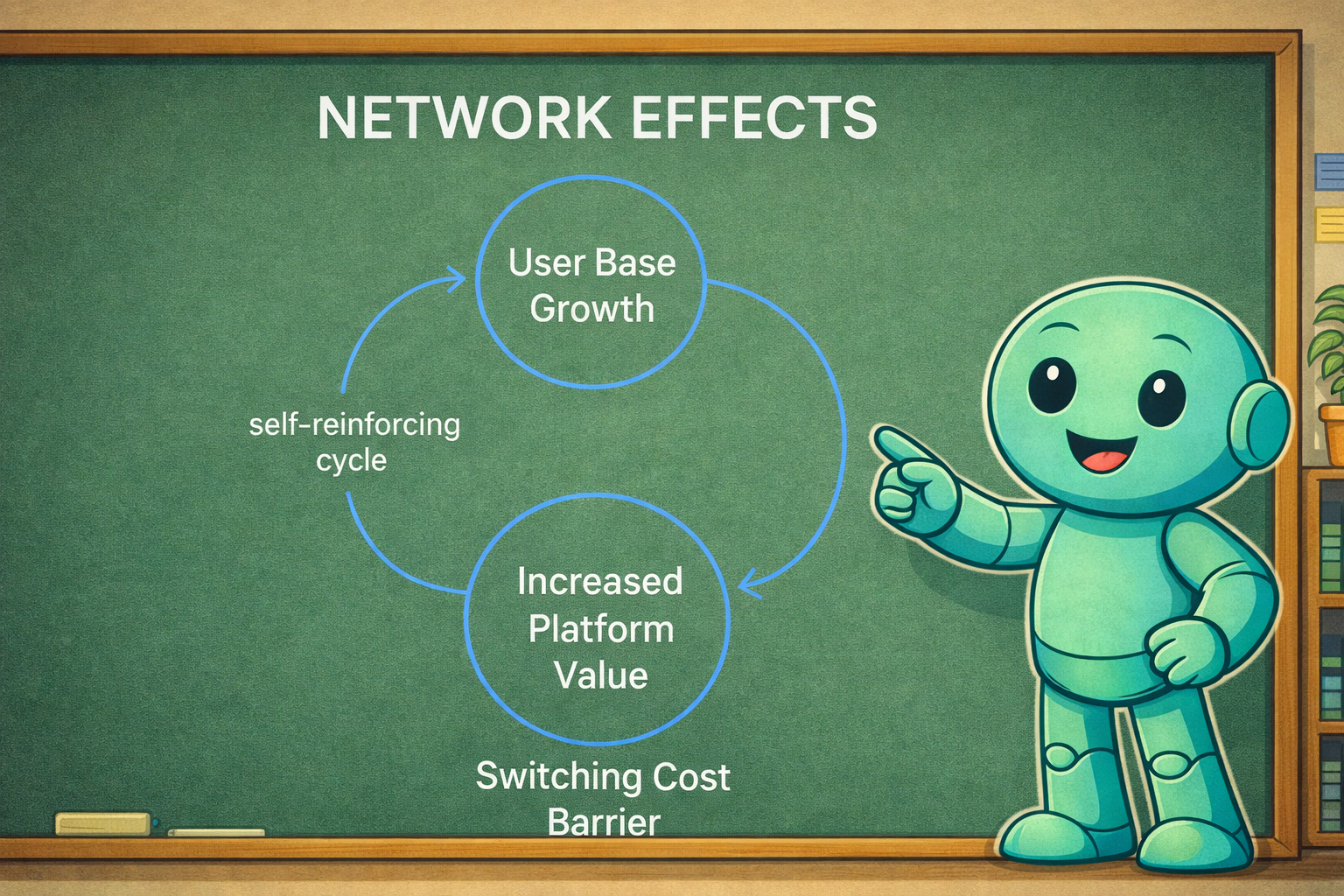
The visualization illustrates how user growth directly enhances platform value, which in turn strengthens the barriers that prevent users from leaving, creating a continuous loop of value creation and defensibility.
Strategic Breakdown: How Network Effects Win
This is one of the most powerful competitive advantage examples in the digital age. A prime example is Meta (formerly Facebook). The value of its social network is not in its technology alone but in the billions of users connected on its platform. A new social network, even with superior features, is useless without the user’s friends and family on it. Similarly, Microsoft Windows dominated the PC market because more users led to more software development, which in turn attracted more users.
- Marketplace Dynamics: Amazon and Uber leverage two-sided network effects. More buyers on Amazon attract more sellers, offering greater product variety, which attracts even more buyers. More riders on Uber attract more drivers, reducing wait times, which then attracts more riders.
- High Switching Costs: As users invest time creating profiles, building connections, and generating data on a platform like LinkedIn, the cost and effort of switching to a competitor become prohibitively high.
- Winner-Take-All Markets: This advantage often leads to a market where one or two dominant players capture the vast majority of value, leaving little room for competitors.
Actionable Takeaways for Your Business
Building a network effect requires a strategic focus on user acquisition and engagement to reach a critical mass.
- Focus on Reaching Critical Mass: Your initial goal should be rapid user acquisition to kickstart the virtuous cycle. Offer incentives or "freemium" models to accelerate adoption.
- Subsidize One Side of the Market: For two-sided platforms, consider subsidizing the more difficult side to attract. For instance, rideshare apps often offer bonuses to new drivers.
- Engineer for Virality: Build features that make it easy and rewarding for users to invite others, such as referral programs or seamless sharing capabilities.
- Continuously Add Value: Once you have users, constantly improve the platform to increase engagement and reinforce the switching costs.
4. Brand Loyalty and Recognition
Brand loyalty and recognition represent a powerful competitive advantage where a company's identity becomes a significant asset. This is built by creating a strong, positive perception through consistent messaging, superior customer experience, and an emotional connection with the audience. This advantage allows a business to command premium prices, benefit from organic word-of-mouth marketing, and retain customers even when faced with lower-priced alternatives.
This strategy, famously executed by giants like Coca-Cola and Nike, transforms a product from a simple commodity into a symbol of a certain lifestyle, quality, or set of values. A strong brand becomes a mental shortcut for consumers, reducing their cognitive load when making purchasing decisions and creating a moat that is incredibly difficult and expensive for competitors to cross.
Strategic Breakdown: How Brand Leaders Win
A prime example is Apple. The company has cultivated a brand synonymous with innovation, minimalist design, and user-friendliness. Its loyalty is so fierce that customers often purchase products across its entire ecosystem, from iPhones to MacBooks, creating a locked-in customer base. Similarly, Harley-Davidson achieves its iconic status by:
- Building a Community: The brand sells more than motorcycles; it sells an identity and a sense of belonging to a tribe.
- Emotional Connection: Harley-Davidson taps into deep-seated values of freedom, rebellion, and American heritage.
- Lifestyle Marketing: Events, merchandise, and owners' groups (H.O.G.) reinforce the brand as a complete lifestyle, not just a product.
Actionable Takeaways for Your Business
Building a brand-based competitive advantage is a long-term commitment that requires consistency and a deep understanding of your target audience.
- Maintain Brand Consistency: Ensure your messaging, visual identity, and tone of voice are uniform across all platforms and customer touchpoints.
- Invest in Customer Experience: Every interaction a customer has with your business should reinforce your brand promise and build trust.
- Create Emotional Connections: Use storytelling and value-driven marketing to connect with customers on a deeper level than just transactional benefits.
- Foster a Community: Engage with your audience through social media, events, and loyalty programs to make them feel like part of a tribe.
A strong brand is one of the most durable competitive advantage examples a business can build. For those starting this journey, it is crucial to understand the foundational steps; you can learn more about creating a brand identity that resonates with your audience.
5. Proprietary Technology and Patents
Proprietary technology and patents form a powerful competitive advantage by granting a company exclusive rights to its innovations. This legal protection, primarily through patents, prevents competitors from using, making, or selling the same technology for a set period, effectively creating a legal monopoly. This advantage allows companies to establish technological leadership, command premium pricing, and erect formidable barriers to entry in their market.
This strategy, pioneered by innovators like Thomas Edison, is central to industries where research and development are critical, such as pharmaceuticals, telecommunications, and software. It transforms intangible intellectual effort into a defensible, revenue-generating asset and is one of the most durable competitive advantage examples available.
Strategic Breakdown: How Innovators Win
A prime example is Qualcomm, which built its empire on a vast portfolio of patents related to wireless communication technologies like CDMA. By licensing its essential patents to nearly every major mobile device manufacturer, Qualcomm secured a steady, high-margin revenue stream and cemented its indispensable role in the industry. Similarly, Pfizer relies on drug patents:
- Exclusive Rights: A patent on a blockbuster drug like Lipitor grants a period of market exclusivity, allowing Pfizer to recoup billions in R&D costs and generate significant profits without direct competition.
- High-Margin Sales: This exclusivity enables premium pricing, as there are no generic equivalents available during the patent’s life.
- Innovation Funding: The profits from patented products are then reinvested into developing the next generation of innovative medicines, creating a virtuous cycle of innovation.
Actionable Takeaways for Your Business
To leverage intellectual property, a business must integrate its IP strategy with its overall business goals.
- File Early and Broadly: Secure patent protection early in the innovation process to protect your core technology before competitors can react.
- Build a Patent Portfolio: Develop a comprehensive portfolio of patents around your key products and technologies to create multiple layers of defense.
- Monitor the Landscape: Actively track competitor patent filings and be prepared to defend your intellectual property against infringement.
- Consider Trade Secrets: For processes that are difficult to reverse-engineer, trade secrets can offer protection without the public disclosure required by patents.
Building this type of advantage requires a long-term commitment to R&D and a sharp understanding of intellectual property law. For those creating new products, you can explore the fundamentals of trademark law to see how it complements your patent strategy.
6. Superior Supply Chain and Distribution
A superior supply chain and distribution network is a formidable competitive advantage built on operational excellence. Companies with this advantage can move goods faster, more reliably, and at a lower cost than their competitors. This operational superiority translates directly into better customer satisfaction through faster delivery, higher product availability, and more competitive pricing, creating a moat that is incredibly difficult for rivals to replicate due to its high capital investment and complexity.
This advantage, pioneered by leaders like Sam Walton and Jeff Bezos, is not merely about logistics; it is about creating an integrated, technology-driven ecosystem. From sourcing raw materials to delivering the final product, every step is optimized for speed and efficiency, making it one of the most durable competitive advantage examples in the physical goods economy.
Strategic Breakdown: How Supply Chain Masters Win
Amazon is the quintessential example. Its advantage is built on a massive network of strategically placed fulfillment centers, advanced robotics, and a proprietary last-mile delivery fleet. This allows for services like Prime two-day (and increasingly same-day) shipping that competitors struggle to match. Similarly, Zara revolutionized fashion with its agile supply chain:
- Rapid Production Cycles: Zara designs, produces, and delivers new styles to stores in a matter of weeks, compared to the industry standard of months.
- Centralized Logistics: A highly centralized distribution system in Spain allows for tight control and rapid shipment of small batches to stores worldwide.
- Data-Driven Inventory: Store managers provide daily feedback on what is selling, which directly informs production decisions, minimizing markdowns and unsold inventory.
Actionable Takeaways for Your Business
Building this advantage requires a relentless focus on efficiency and a willingness to invest heavily in infrastructure and technology.
- Invest in Technology: Use modern software for demand forecasting, inventory management, and route optimization to eliminate inefficiencies.
- Build Strategic Partnerships: Cultivate strong, collaborative relationships with key suppliers and logistics partners to ensure reliability and favorable terms.
- Optimize Inventory Levels: Implement just-in-time (JIT) or similar inventory strategies to reduce holding costs and improve cash flow.
- Focus on Key Metrics: Continuously track and improve Key Performance Indicators (KPIs) like order fulfillment time, inventory turnover, and shipping accuracy.
A world-class supply chain provides a powerful defense against competitors by creating a superior customer experience and a more resilient, cost-effective operational model.
7. Access to Exclusive Resources
A powerful competitive advantage arises when a company secures privileged or exclusive access to scarce and valuable resources that rivals cannot easily obtain or replicate. This advantage is not just about ownership; it's about control over critical inputs that can dictate cost, quality, and market access. These resources can range from raw materials and prime real estate locations to unique talent pools and low-cost capital.
This form of competitive advantage creates high barriers to entry, as competitors are effectively locked out of the essential components needed to compete on an even playing field. This strategy, famously employed by industry pioneers like Cecil Rhodes with De Beers, is about building a moat around the very source of value creation.
Strategic Breakdown: How Resource Control Creates Dominance
A prime example is Saudi Aramco, the Saudi Arabian national petroleum company. Its exclusive access to the kingdom's vast, low-cost oil reserves gives it a structural cost advantage that no international competitor can match. This allows it to remain profitable even when oil prices are low. Similarly, McDonald's built an empire not just on burgers, but on real estate:
- Prime Locations: Ray Kroc’s strategy focused on owning the land and buildings where its franchises operate. This provides a steady, appreciating asset base and control over the best consumer traffic locations.
- Talent Exclusivity: Google maintains its edge in AI and software engineering by creating an ecosystem that attracts and retains the world’s top talent, making it a near-exclusive resource pool.
- Capital Access: Berkshire Hathaway, led by Warren Buffett, leverages its formidable reputation and massive cash reserves to access capital at a lower cost than others, enabling it to make investments and acquisitions on uniquely favorable terms.
Actionable Takeaways for Your Business
To cultivate an advantage through resource access, a business must think strategically about its supply chain and essential inputs.
- Secure Long-Term Contracts: Lock in favorable terms and guarantee supply by negotiating long-term agreements with critical resource providers.
- Invest in Relationships: Build strong, mutually beneficial relationships with suppliers, landowners, or key talent sources to gain preferential treatment and access.
- Consider Vertical Integration: For absolutely critical resources, acquiring the supplier (vertical integration) can provide ultimate control over supply and cost.
- Monitor Market Trends: Stay ahead of shifts in resource availability and cost to anticipate scarcities and secure access before competitors do.
This strategy requires foresight and often significant capital investment, but it can create one of the most durable and defensible competitive advantage examples in any industry.
8. Operational Excellence and Efficiency
Operational excellence is a competitive advantage centered on refining internal processes to a state of maximum efficiency and quality. This strategy goes beyond simple cost-cutting; it involves creating a corporate culture dedicated to continuous improvement, waste elimination, and superior process management. By optimizing how work gets done, companies can deliver higher quality products and services faster and more reliably than competitors, often at a competitive cost.
This approach, pioneered by figures like W. Edwards Deming and Toyota’s Taiichi Ohno, creates a formidable, hard-to-replicate advantage because it is embedded in the organization's culture and daily routines. It's not about a single product or patent but about building a superior operating engine that consistently outperforms rivals.
Strategic Breakdown: How Operational Leaders Win
A prime example is Toyota and its legendary Toyota Production System (TPS). Its competitive advantage is built on a philosophy of "lean manufacturing" and continuous improvement (Kaizen) that empowers every employee to identify and eliminate waste. Another leader is Southwest Airlines, which achieves operational excellence through:
- Standardized Fleet: Using only Boeing 737 aircraft simplifies maintenance, pilot training, and crew scheduling, drastically reducing operational complexity and costs.
- Rapid Turnaround: Southwest perfected a 25-minute turnaround process for its planes, keeping them in the air generating revenue more than any other airline.
- Point-to-Point Routes: Bypassing the traditional hub-and-spoke model reduces delays and increases the efficiency of its network.
Actionable Takeaways for Your Business
To build an advantage through operational excellence, a business must foster a culture where efficiency and quality are paramount.
- Implement Continuous Improvement: Adopt methodologies like Lean (to eliminate waste) or Six Sigma (to reduce defects) as a core part of your operations.
- Empower Your Employees: Train and empower your team to identify process bottlenecks and suggest improvements. The best ideas often come from those closest to the work.
- Leverage Data Analytics: Use data to pinpoint inefficiencies, monitor key performance indicators (KPIs), and make informed decisions about process changes.
- Standardize Key Processes: Document and standardize core workflows to ensure consistency, reduce errors, and make it easier to train new staff and scale operations.
This strategy requires a long-term commitment to process refinement and cultural change. For companies that master it, operational excellence is one of the most durable competitive advantage examples, creating a resilient and highly efficient organization.
Competitive Advantage Examples Comparison
| Strategy / Advantage | Implementation Complexity ? | Resource Requirements ? | Expected Outcomes ? | Ideal Use Cases ? | Key Advantages ⭐ |
|---|---|---|---|---|---|
| Cost Leadership | Moderate to High - requires process optimization and supplier negotiations | High - investment in technology, bulk purchasing, and lean operations | Lower costs, competitive pricing, increased market share | Industries with scale economies and price-sensitive customers | Cost advantage, market share growth, price war resilience |
| Product Differentiation | High - involves R&D, branding, and customer insights | High - innovation, marketing investment, quality control | Premium pricing, customer loyalty, reduced price sensitivity | Markets valuing unique features and brand strength | Premium pricing, customer retention, competitive insulation |
| Network Effects | Very High - building critical mass and platform improvements | High - platform development, user acquisition efforts | Exponential growth, market dominance, viral expansion | Platforms, marketplaces, social networks | Self-reinforcing growth, high switching costs, natural monopoly |
| Brand Loyalty and Recognition | High - consistent messaging, experience, and emotional engagement | High - marketing, customer experience investments | Repeat purchases, premium pricing, reduced marketing costs | Consumer brands with emotional appeal and repeat buyers | Strong customer retention, pricing power, resilience |
| Proprietary Technology and Patents | High - requires heavy R&D and legal protection | Very High - R&D, patent filing, legal enforcement costs | Legal monopoly, licensing revenue, premium pricing | Tech and pharma industries with innovation focus | IP protection, revenue streams, competitive barriers |
| Superior Supply Chain and Distribution | High - complex logistics and technology integration | High - infrastructure, partnerships, and technology | Lower costs, faster delivery, operational flexibility | Retail, manufacturing, logistics-intensive businesses | Cost savings, customer service, operational excellence |
| Access to Exclusive Resources | Moderate to High - securing contracts, exclusive rights | Moderate to High - resource acquisition, talent sourcing | Cost and quality advantages, entry barriers | Industries reliant on scarce inputs or prime assets | Sustainable advantage, cost/quality benefits, entry barriers |
| Operational Excellence and Efficiency | Moderate to High - continuous process improvement and quality systems | Moderate to High - training, technology, process management | Consistent quality, cost reduction, faster time-to-market | Manufacturing, service sectors focusing on reliability | Cost efficiency, quality improvement, scalable processes |
From Examples to Execution: Building Your Competitive Edge
The journey through these diverse competitive advantage examples, from Walmart's cost leadership to Apple's brand loyalty and product differentiation, reveals a fundamental business truth: market leadership is not accidental. It is the direct result of deliberate, strategic choices that create a defensible position against competitors. We've seen how companies like Amazon don't rely on a single strength but weave together multiple advantages-operational excellence, network effects, and a superior supply chain-into a nearly impenetrable fortress.
The core lesson is that a competitive advantage isn't a static achievement. It is a dynamic process of identifying what your organization can do uniquely well and then relentlessly investing in and protecting that capability. The examples explored throughout this article are not just historical case studies; they are blueprints for strategic thinking. They demonstrate that whether you are a startup or an established enterprise, the path to a sustainable edge lies in creating value that is difficult for others to replicate.
Synthesizing the Strategies: From Theory to Action
The eight categories we analyzed provide a comprehensive framework for evaluating and building your own market position. A quick recap highlights the central theme of each:
- Cost Leadership & Operational Excellence: These are about mastering internal processes to deliver value more efficiently than anyone else. It requires a culture of continuous improvement and discipline.
- Product Differentiation & Brand Loyalty: This is the art of creating perceived and real value in the minds of consumers. It's about being not just different, but meaningfully better or more desirable.
- Network Effects & Superior Distribution: These advantages build momentum. Each new customer or distribution point makes the business stronger, creating a self-reinforcing cycle of growth.
- Proprietary Technology & Exclusive Resources: These are about owning something no one else has. Whether it's a patent, a trade secret, or a unique natural resource, these advantages create high barriers to entry.
Your first step is not to try and master all of these at once. Instead, perform a strategic audit of your own business and its operating environment. Where do your inherent strengths lie? What unique assets or capabilities can you leverage? The most powerful competitive advantages often emerge at the intersection of what your business does best and what your customers value most.
Your Roadmap to Building a Competitive Moat
Understanding these competitive advantage examples is only the beginning. The real work starts with implementation. Here is a practical roadmap to translate these insights into a tangible strategy for your own business:
- Identify Your Core Competency: What is the one thing your business can do better than anyone else? Is it your innovative product design, your hyper-efficient logistics, or your ability to build an authentic community around your brand? Focus your energy here.
- Analyze Your Competitive Landscape: Map out your competitors. What advantages are they leveraging? More importantly, where are the gaps? A competitor's weakness can become the foundation of your strength.
- Choose Your Primary Advantage: Select one or two advantage types from our list that align with your core competency and the market gaps you've identified. A B2B software company might focus on proprietary technology, while a direct-to-consumer brand might prioritize brand loyalty.
- Develop Tactical Initiatives: Break down your chosen advantage into actionable steps. If you're pursuing product differentiation, your initiatives might include investing in R&D, sourcing higher-quality materials, or creating a superior user experience design.
- Measure, Iterate, and Defend: A competitive advantage requires constant nurturing. Track key metrics related to your advantage (e.g., customer retention for brand loyalty, production cost for cost leadership). Adapt to market changes and proactively look for ways to strengthen your position.
Ultimately, building a competitive edge is a marathon, not a sprint. It's about making consistent, strategic investments that compound over time. The examples of companies like Tesla, Starbucks, and Google prove that a well-defined and executed competitive strategy is the most reliable path to not just surviving, but thriving in a crowded marketplace. It transforms your business from just another option into the only choice for your target customer.
A powerful brand name is often the first touchpoint in establishing your competitive identity. It's the vessel that carries your story of differentiation and value. Let NameRobot's intelligent tools help you generate a memorable and strategic name that aligns with your competitive advantage and sets the stage for market leadership. Find your perfect business name today at NameRobot.