Brand Name Availability Search: Find Your Perfect Name
So you've found it. That perfect name. It feels right, it sounds great, and you can already picture it on your website. It's a fantastic feeling, but hold on for just a moment before you run off to print business cards. The most critical step is still ahead: the brand name availability search.
Want to check a serious name candidate? Use NameScore for a structured first assessment before you commit time, budget, or launch work.
This isn't just a quick check-the-box exercise. It's a deep, multi-layered investigation to confirm your chosen name is truly yours for the taking—legally and digitally. Think of it as your first line of defense against messy legal disputes, customer confusion, and the gut-wrenching cost of a forced rebrand down the road.
Why You Absolutely Cannot Skip a Brand Name Search

You’ve poured your heart into finding a name that nails your brand’s identity. But skipping a thorough search is one of the biggest gambles you can take as a founder. It's not just about finding someone with the exact same name; it’s about protecting the very foundation of your business.
I’ve seen it happen. A company launches with a brilliant marketing campaign, only to get slapped with a cease-and-desist letter from a business they never knew existed. Suddenly, they’re facing a complete, budget-draining rebrand, losing all the momentum and brand equity they just started to build. It's a nightmare scenario, and it's entirely avoidable.
A Very Crowded Global Marketplace
The modern economy is packed. We're talking about a global marketplace where the total number of active trademarks is on track to blow past 100 million in the next few years. To put that in perspective, at the end of 2023, there were already around 83.6 million active trademarks—a jump of over 150% since 2016. These numbers aren't just trivia; they highlight the critical need for careful brand protection. You can read more about these trends and what they signal for new businesses.
This trademark explosion means the pool of truly original names is shrinking by the day. A name that feels unique in your city could easily be a registered brand in a key international market you hope to enter one day.
A proper brand name search isn't just a formality. It's a strategic imperative that secures your legal standing, protects your digital real estate, and gives you the confidence to invest in your brand for the long haul.
The Core Components of a Brand Name Search
A real search goes way beyond a simple Google query. It’s a systematic review of several key areas to make sure your name is clear for use. Miss just one, and you could leave a door open to future problems.
Before we dive into the "how-to," let's break down the essential areas you need to investigate. Each piece of the puzzle is crucial for getting a complete picture of your name's availability.
Core Components of a Brand Name Search
| Search Area | What You're Looking For | Why It Matters |
|---|---|---|
| Trademark Databases | Exact matches, phonetic similarities, and names in related business categories. | This is your most important legal check. Overlooking a registered trademark, even an indirect one, can lead to infringement claims. |
| Domain Availability | Availability of your desired name with top-level domains (TLDs) like .com, .io, or country-specific extensions. | Your domain is your primary digital address. An unavailable .com can force compromises that dilute your brand identity online. |
| Social Media Handles | Consistent and available usernames across key platforms (Instagram, X, Facebook, TikTok, LinkedIn). | Securing matching handles is vital for brand consistency and audience engagement in a social-media-driven market. |
| General Web Search | Unregistered businesses, projects, or products using a similar name that could cause market confusion. | Even without a trademark, a pre-existing brand can claim "common law" rights and make it difficult for you to operate. |
Looking at this, it's clear that a comprehensive search is about more than just avoiding a lawsuit. It’s about building a cohesive and defensible brand presence from day one.
Diving into Global Trademark Databases

Alright, this is where the rubber really meets the road. After you've done a basic web search, the real test of your brand name’s strength begins with a deep dive into official trademark databases. This isn't just a formality; it's the legal bedrock of your brand's future. It’s what separates a professional launch from a costly mistake.
I’ve seen it happen countless times. A founder falls in love with a name like "AuraFlow" for their new software. The domain is open, social handles are free, and everything looks good to go. But then a quick check of the United States Patent and Trademark Office (USPTO) database reveals an active trademark for "Aura Flow" in the exact same software category. Moving forward with that name would be walking straight into a potential infringement lawsuit.
This is a classic—and completely avoidable—pitfall. The global trademark landscape is a minefield of registered names, and a thorough search is your best defense against stepping on one.
The Essential Databases to Check First
Even if your ambitions are local for now, you need to think globally from day one. You're not just picking a name for today; you're future-proofing your brand. To get a solid read on your name's availability, there are three databases you absolutely must search:
- USPTO (United States): As the world's largest consumer market, the US is a non-negotiable search. If you have any plans to sell to American customers, this is your first stop.
- EUIPO (European Union): This is a huge time-saver. One search here covers all 27 EU member states, giving you a clear picture across a massive economic bloc.
- WIPO (Global): The World Intellectual Property Organization’s database is your window into international registrations. It gives you that crucial, high-level view of brands protected across multiple countries.
Don’t get tunnel vision looking only for exact matches. The real danger often lurks in names that are "confusingly similar." Think phonetic twins like "Kwik" vs. "Quick" or names that create a similar commercial impression within the same industry.
Why You Need to Search Beyond the Obvious
The art of a good trademark search is learning to spot these less-obvious conflicts. Just typing your exact name into the search bar is barely scratching the surface. You have to anticipate how a trademark examiner—or a competing brand's lawyer—might see it.
For example, if your chosen name is "Zenith Tech," your search shouldn't stop there. You need to explore variations like "Zeneth," "ZenithTek," and other phonetic spellings that could cause confusion in the marketplace.
Context is also critical. Trademarks are registered in specific categories for goods and services known as Nice Classes. The name "Pioneer" might already be trademarked by a construction company (Class 37), but that doesn't necessarily stop you from registering "Pioneer" for your new coffee brand (Class 30).
This is where NameRobot's tools can really help you sift through the noise and understand these classifications. And if you’re still in the early stages, using a brand name generator that considers these legal factors from the start can save you a world of trouble down the line.
Getting this part of the process right gives you the confidence that your name isn’t just memorable, but legally sound. It's the essential groundwork you need to lay before spending a single dollar on a logo, website, or marketing campaign.
So, you've waded through the trademark databases. Good. That's a huge, often intimidating, part of the process. But the job isn't done yet. Now, we shift from legal availability to practical, digital availability. This is where you secure your brand's home on the internet.
Think of it this way: your online presence is your modern-day storefront, your business card, and your direct line to customers, all at once. I've seen too many entrepreneurs get excited about a legally clear name, only to find out the matching .com was bought a decade ago and the Instagram handle belongs to a cat. It's a frustrating setback that immediately fractures your brand's image before you even launch.
This infographic lays out the ideal workflow pretty clearly.
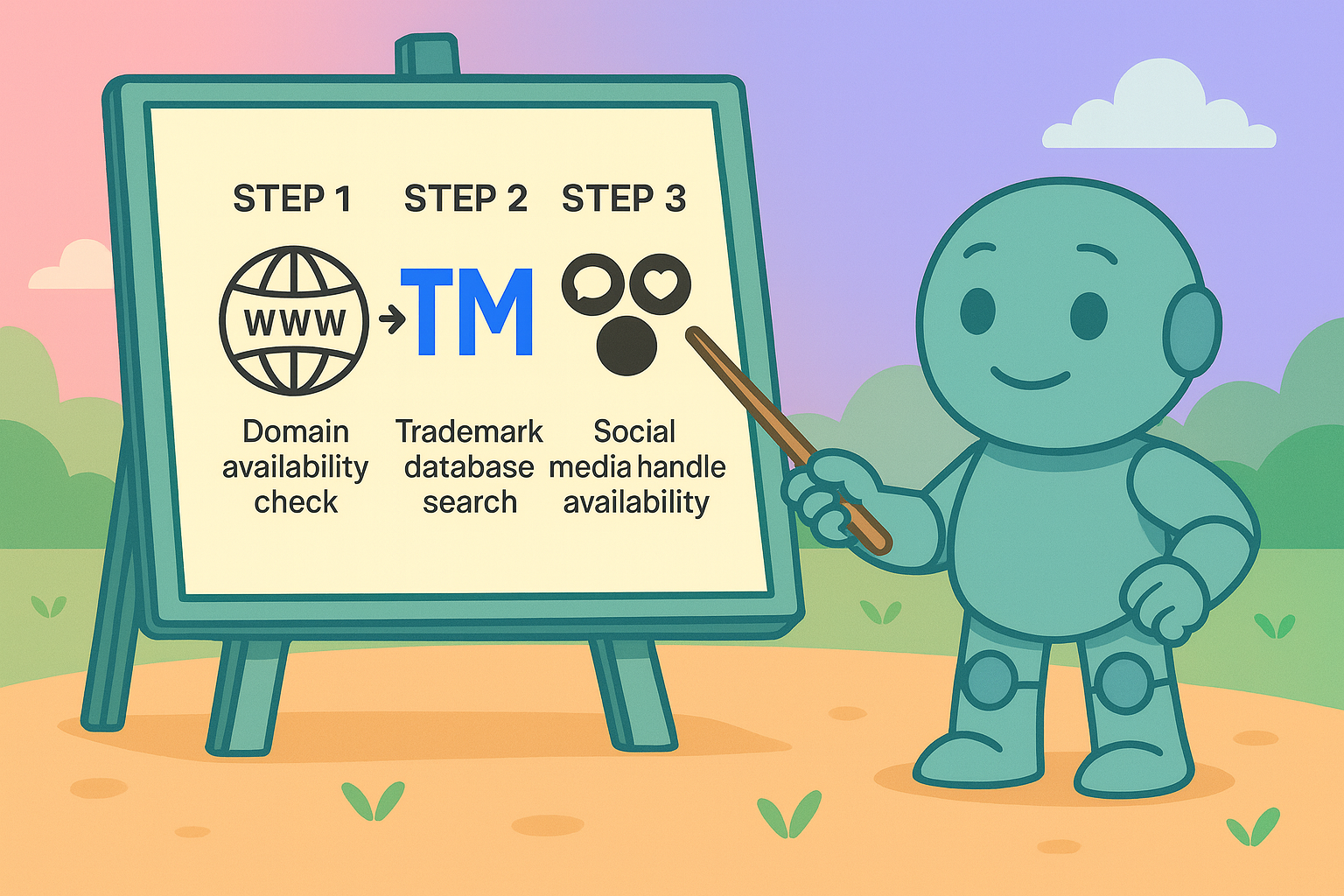
As you can see, checking your domain, trademark, and social media handles aren't separate tasks. They're three parts of one single, essential investigation into your name's viability.
Finding Your Digital Home with a Domain Check
Let's start with the cornerstone of your online identity: your domain name. While there are countless new extensions available, the .com is still king. It's what people instinctively type into their browser, and it carries a certain weight and authority that other TLDs (top-level domains) just don't have yet.
The most straightforward approach is to use a dedicated domain checker. Manually punching your name into different registrars is a slow, painful process. A good tool gives you a bird's-eye view of what's available across dozens of TLDs in seconds.
For instance, a tool like NameRobot’s Domain Check gives you a clean, immediate report card on your name's availability. This kind of instant feedback is invaluable. You can quickly see if the .com is a no-go and immediately pivot to considering other strong alternatives like .io, .co, or a country-specific domain that makes sense for your business.
Claiming Your Space on Social Media
Once you have a handle on your domain options, the focus turns to social media. The goal here is consistency. Having @YourBrand on Instagram but @YourBrandOfficialUS on X creates a disjointed experience for anyone trying to find you. It dilutes your brand's power.
You need to check for your desired handle on the platforms that actually matter to your audience. Don't waste time on platforms you'll never use. For most businesses, the checklist includes:
- Instagram: A must for any brand with a visual component, especially in B2C.
- X (formerly Twitter): The go-to for real-time news, public conversations, and customer support.
- Facebook: Still a powerhouse for building communities and running highly targeted ad campaigns.
- LinkedIn: Non-negotiable for B2B companies, consultants, and professional services.
- TikTok: Essential if you're targeting younger audiences with short-form video.
A quick tip from experience: Don't panic if your first-choice handle is taken. Simple, professional-sounding modifiers can work wonders. Adding a prefix or suffix like "get," "app," "hq," or "co" can create a clean, memorable alternative. If "Thrive" is taken, "GetThrive" or "ThriveHQ" are excellent, on-brand workarounds.
By tackling domain and social media checks with this kind of systematic approach, you're not just finding a name—you're building a cohesive digital identity. This groundwork ensures that when a potential customer goes looking for you, they find a strong, consistent, and professional presence everywhere they look. It’s the first step in building trust.
Anticipating Future Risks with Global Filing Trends
A truly strategic brand name availability search goes beyond a simple "is this name taken?" check. It's about playing the long game. You have to look at the board and anticipate where your business might be in five or even ten years. Intellectual property is a moving target, and understanding global trademark filing trends can give you a serious advantage, helping you sidestep conflicts before they ever become a problem.
This kind of forward-thinking means looking past your own backyard. Even if your current plan is to stay local, what happens in major economic hubs can create ripple effects that eventually wash up on your shore. Ignoring these global currents is like sailing without checking the weather—you might have clear skies for now, but you could be sailing straight into a storm.
Let’s get specific. A few key regions heavily influence the global brand protection scene. Mainland China, for example, is in a league of its own, filing millions of trademark applications every year. The United States is next with over half a million annually. And you can’t ignore India, which is rapidly gaining ground with an average annual filing growth of 10% over the last decade. You can dig deeper and discover more about these influential trademark portfolios to see just how much activity is happening.
Why Filing Hotspots Matter to You
I get it. You might be thinking, "I run a small shop in Ohio. Why should I care about filing surges in China or India?" The answer is simple: global commerce is deeply interconnected, and many countries operate on a "first-to-file" basis.
A company in one of these high-volume regions could easily register a name that’s identical or confusingly similar to yours. If you ever decide to expand your market or even just source materials from that country, you could find your brand is already blocked. It happens more often than you'd think.
A proactive brand name availability search considers not just currently registered marks but also the velocity and direction of new applications globally. It’s about securing your name for the business you want to become, not just the one you are today.
Practical Steps for a Future-Proof Search
So, how do you actually build this global perspective into your search? It’s not about boiling the ocean, but about adding a layer of strategic thinking.
Here’s what I recommend:
- Monitor High-Growth Markets: Keep an eye on trademark databases in fast-growing economies. Think India and Brazil. Even if you have no immediate plans to go there, their dynamic filing environments are often breeding grounds for future brand conflicts.
- Analyze Your Supply Chain: Where do your products come from? Where are your key partners located? A trademark conflict in one of those regions can cripple your operations just as badly as one in your home market.
- Think About Your Five-Year Plan: Be realistic about your ambitions. If international expansion is even a faint blip on your radar, doing a broader international search now is a smart investment. It’s far cheaper than a forced rebrand down the line.
When you add this global awareness to your process, your search stops being a simple defensive task. It becomes a powerful strategic tool that gives your brand the room it needs to grow without hitting unexpected legal walls.
Avoiding Common and Costly Search Mistakes
A thorough brand name availability search is your brand’s first line of defense, but it’s a process filled with potential missteps that can leave your new venture exposed. From my experience, the most common error is relying on a single search method. Just because a quick Google search comes up empty doesn't mean your name is truly in the clear.
I’ve seen entrepreneurs get that rush of excitement because a name isn't on the first page of search results, only to later receive a cease-and-desist letter from a registered trademark owner. That discovery forces a complete and costly rebrand. A simple web search is only one piece of a much larger, more complex puzzle.
Another frequent oversight is underestimating phonetic similarities. A trademark office isn't just looking at the exact spelling; they're considering whether two names sound alike enough to confuse the average consumer. For example, a name like "KwikFix" could easily be flagged for infringing on an existing "QuickFix" trademark, especially if they operate in the same industry.
Overlooking Conceptual and Category Conflicts
Beyond names that just sound alike, you have to dig deeper and consider conceptual similarities. Does your name create the same overall commercial impression as another brand, even if the words themselves are totally different? This kind of nuance is where many do-it-yourself searches fall short.
It’s also crucial to search across all relevant business categories, not just your primary one. Let's say you're launching a new fitness app. Your search shouldn't stop there. You need to check for similar names in wellness, nutrition, and even apparel categories, as brand extensions into these areas are incredibly common. To really get a handle on this, our guide on how to do a trademark search offers a detailed beginner's roadmap.
This level of detail isn't optional in today's crowded market. The global trademark services market is projected to hit $18 billion, a number driven by staggering filing volumes. China, for instance, submits millions of trademark applications annually. The EUIPO processes over 500,000 applications, and India’s filings have surged past 400,000. These figures paint a clear picture of the fierce competition for unique brand names. You can learn more about these key trademark statistics and what they mean for your brand.
One of the most significant yet overlooked mistakes is failing to document your search process. A detailed record of the databases you checked, the keywords you used, and the dates of your searches can be invaluable if a legal dispute ever arises.
Your Defensive Search Checklist
To make sure your search is both methodical and defensible, you need to treat it like a formal investigation. Think of this checklist as your game plan for covering all the bases and avoiding the common pitfalls that can derail a new brand before it even gets off the ground.
-
Go Beyond Google: Your search must include dedicated queries on official trademark databases like the USPTO, WIPO, and EUIPO.
-
Search for Similarities: Don't just search for your exact name. Actively look for phonetic (Kwik vs. Quick), conceptual (Sunrise vs. Dawn), and even common misspellings.
-
Check All Relevant Categories: Don't limit your search to your primary business class. Investigate adjacent industries where a consumer might reasonably get confused.
-
Secure Digital Real Estate: Look for domain availability (prioritizing the .com) and aim for consistent social media handles across all platforms that matter to your audience.
-
Document Everything: This is your "due diligence" file. Keep a detailed log of your searches, including dates, the databases you used, search terms, and screenshots of important results.
Common Questions About Brand Name Searches
Even with a solid plan, running a brand name availability search can feel a bit daunting. You're bound to have questions pop up along the way. Getting clear, practical answers is the key to moving forward with confidence instead of second-guessing every move. Let's walk through some of the most common things people ask.
How Deep Does My Search Need To Be?
A quick Google search just won't cut it. To do this right, your search needs to be comprehensive, covering three critical areas:
- Official Trademark Databases: This is non-negotiable. You need to be looking at official registries like the USPTO in the U.S. and WIPO for international protection.
- Domain Name Availability: Check for your desired name across all the top-level domains (TLDs) that matter to your business—.com, .co, .io, and any country-specific ones.
- Social Media Handles: Scour the major platforms (Instagram, Facebook, X, TikTok, LinkedIn) to see if your name is already in use, even informally.
The whole point is to find any existing use - registered or not - that could muddy the waters or land you in legal trouble down the road. While the exact depth might shift based on your industry and where you plan to grow, this three-pronged approach is the professional standard for avoiding future headaches.
What If My Desired Name Is Already Trademarked?
Finding out your favorite name is already taken can feel like hitting a brick wall. But don't panic just yet; the details matter immensely. If a name that's identical or "confusingly similar" is already registered for products or services in your field, the smartest (and safest) move is to head back to your list of alternatives.
But what if the trademark is for a totally different industry? Or it's registered in a country you have zero plans to do business in? In those cases, you might have an opening. This is precisely when it pays to talk to a trademark attorney. They can analyze the specific situation and give you a realistic assessment of the risk involved.
A registered business name is not the same as a trademark. Filing for an LLC or corporation gives you the right to operate under that name, but it gives you zero brand protection. A trademark, on the other hand, is intellectual property. It's what allows you to legally stop others from using a similar name in your market.
This is a critical distinction that many entrepreneurs miss. For a more detailed explanation, check out our guide on what you need to know about brand names.
Can I Do The Search Myself or Do I Need A Lawyer?
The answer is both. You absolutely can—and should—do the initial screening yourself. Using online tools and databases, like those within NameRobot, for a preliminary brand name availability search is an essential first step. It's a fantastic way to quickly weed out the non-starters without spending a dime on legal fees.
However, once you've landed on a final candidate, hiring a trademark attorney for a formal "clearance search" is the gold standard. They bring a level of expertise and access to specialized databases that you simply can't replicate. More importantly, they interpret the findings through the complex lens of trademark law, giving you a professional legal opinion on the name's viability. It’s an investment in peace of mind.
Ready to stop guessing and start building? The NameRobot platform is designed to help you generate, evaluate, and check your brand name ideas with confidence. We've integrated powerful AI name generators with instant trademark and domain checks, giving you all the data you need in one place. Find a creative, available, and legally sound name for your business today at https://namerobot.com.