Measuring Brand Value: Key Metrics & Best Practices
So, what do we actually mean when we talk about measuring brand value? At its core, it’s the process of assigning a real, hard financial figure to your brand, treating it just like any other business asset. This means looking at everything from financial performance and customer loyalty to its overall market position to figure out its monetary worth. It’s how we turn a fuzzy, intangible concept into a concrete number that drives business growth.
Want to check a serious name candidate? Use NameScore for a structured first assessment before you commit time, budget, or launch work.
Why Measuring Brand Value Is a Business Imperative

In a crowded marketplace, your brand is so much more than just a logo or a line item on the marketing budget, it’s a powerful financial asset. The days of waving our hands and calling branding an abstract, unmeasurable effort are long gone. Today, investors, executives, and other key stakeholders expect to see clear, data-driven proof of a brand's performance and its contribution to the bottom line.
This change in thinking demands a new approach. When you measure brand value, you create a direct, undeniable link between your marketing activities and real financial results. Being able to put a dollar figure on your brand unlocks some serious strategic advantages.
- Smarter Strategic Planning: When you have quantifiable data, your leadership team can make much sharper decisions on everything from market expansion and product development to where to allocate resources.
- Stronger Investor Confidence: A well-documented, high brand value can dramatically increase a company's appeal during mergers, acquisitions, or critical funding rounds.
- Better Marketing ROI: By pinpointing which activities actually strengthen the brand, you can fine-tune your marketing spend for the greatest possible impact.
From Abstract Concept to Economic Indicator
Perhaps the biggest shift is that brand value is now treated as a key economic indicator. It gives you a solid, data-backed foundation for justifying budgets, proving long-term worth, and showing resilience, especially when markets get shaky. And this isn't just an internal metric anymore; it's gained recognition on a global scale.
Since 2020, the Global Innovation Index (GII) has officially included brand value as a core indicator for measuring innovation across entire economies. This move underscores just how vital strong brands are to national economic health and competitiveness. The GII now sums the total value of each country's top brands relative to its GDP. You can explore the full details of this development and see its impact on the global economy.
A brand's value is the observable, measurable outcome of its equity. It is the financial benefit a company receives from developing positive, strong connections with its customers. It translates consumer sentiment into a concrete asset on the balance sheet.
The Three Core Pillars of Brand Value
At the end of the day, measuring brand value isn't just an accounting task; it’s a strategic necessity that brings clarity and focus. It proves that a powerful brand isn't just a nice-to-have, it's one of the most reliable engines for sustainable growth and long-term financial success. To really get a handle on this, it helps to break the concept down into its three core components.
The table below outlines these essential pillars, which form the foundation of any credible brand valuation.
The Three Core Pillars of Brand Value
Pillar
| Description
| Example Metric
|
|---|---|---|
Financial Performance
| The direct revenue and profit attributable to the brand's influence.
| Price Premium or Revenue Contribution
|
Customer Perception
| The strength of customer loyalty, awareness, and emotional connection.
| Net Promoter Score (NPS)
|
Market Strength
| The brand's competitive position and influence within its industry.
| Market Share or Share of Voice
|
By understanding how these three areas work together, you can start building a comprehensive picture of what your brand is truly worth.
Essential Metrics for Quantifying Brand Strength

Before you can put a dollar figure on your brand, you have to get your hands dirty with the data. What signals actually reveal your brand’s strength and influence in the market? To measure brand value properly, you need to track a smart mix of metrics that tell the whole story from hard financials to the softer side of customer feelings.
These indicators are the foundation of any valuation that holds up to scrutiny.
A great place to start is with financial performance directly linked to your brand. One of the most revealing metrics I always look at is price premium. This is simply how much more customers will happily pay for your product over a generic or competing one. A high price premium is a crystal-clear sign of strong brand preference and perceived value.
Think about it this way: a boutique coffee shop might charge $1.50 more for a latte than the generic cafe down the street. That extra margin isn't just profit. It's a tangible, financial measure of the value people see in that specific brand experience, from the vibe of the shop to its hard-earned reputation.
Gauging Customer Loyalty and Sentiment
Financials give you a solid baseline, but customer-centric metrics provide the soul. This is where you uncover the "why" behind the buy, which is essential for a complete picture of your brand's value.
A brand's strength is ultimately determined by its audience. Metrics that capture customer loyalty and advocacy are not just 'soft' data; they are leading indicators of future revenue and market resilience.
Here are a few of the most critical customer metrics you should be tracking:
- Net Promoter Score (NPS): This classic metric gets right to the point by asking one simple question: "How likely are you to recommend our brand?" A high NPS is a powerful indicator of organic word-of-mouth marketing and sticky customer relationships.
- Customer Lifetime Value (CLV): CLV projects the total revenue you can expect from a single customer over their entire relationship with you. When CLV is on the rise, it tells you the brand is building loyalty that pays off in the long run.
- Brand Awareness Surveys: Using both aided and unaided recall surveys, you can find out how top-of-mind your brand is. If customers immediately think of you when a problem arises, you’ve captured significant mindshare.
Tracking these gives you a clear window into your brand equity the sum of all perceptions and feelings consumers have about your brand. While they're related, it's crucial to separate this concept from the final financial valuation. For a deeper dive, our guide on how to measure brand equity offers a really practical approach.
Analyzing Your Position in the Market
Finally, no brand exists in a vacuum. You need to zoom out and see how you stack up against the competition. Market-level metrics give you this crucial external perspective, connecting your internal efforts to how you're actually performing out in the wild.
A key metric here is Share of Voice (SoV). This is all about how much of the conversation in your industry your brand owns, measured across social media, PR, and advertising. A dominant SoV is a strong sign of market leadership and visibility.
Then there's the classic market share, or your slice of the total sales pie in your industry. While things like pricing and distribution play a part, a powerful brand is an incredible defense for protecting and growing market share, especially when new challengers appear. By weaving these financial, customer, and market metrics together, you build a much more comprehensive and defensible case for your brand's true value.
Choosing Your Brand Valuation Model
Measuring brand value isn't a simple, one-size-fits-all exercise. The method you choose completely shapes the outcome, so picking the right one is critical. Think of it less like following a rigid formula and more like a seasoned craftsman selecting the perfect tool for the job. Your choice depends entirely on your objective are you prepping for an M&A deal, justifying marketing spend to the board, or simply tracking internal progress?
Financial analysts and brand strategists generally lean on three primary methodologies. Each looks at value from a different angle, and the best approach for you might even be a hybrid of all three. Let's break down how they work.
The Cost Approach
This model answers a very direct question: What would it cost to rebuild this brand from the ground up, right now? It's a retrospective approach, tallying up all historical investments from marketing campaigns and creative development to trademark registration fees.
Because it's based on actual, historical spending, the Cost Approach is often favored by accountants. It provides a tangible, defensible number, which is particularly useful for newer companies or those with a limited performance history looking for a baseline valuation.
The significant limitation here is that it measures effort, not results. It completely ignores customer goodwill, market perception, and future earning potential. A brilliant, low-cost viral campaign that created massive brand equity would be seriously undervalued by this model alone.
The Market Approach
The Market Approach operates a lot like a real estate appraisal. You determine your brand's value by looking at what similar brands have recently sold for. This is the go-to method during mergers and acquisitions because it's grounded in real-world, transactional data.
To make this work, you need solid data on comparable transactions. For instance, if a direct competitor of a similar size and market share was recently acquired, the price paid for that brand provides a powerful benchmark for your own. You're essentially letting the market set the price.
The biggest hurdle with the Market Approach is finding the data. Details of private company sales are often kept under wraps, making it tough to find truly comparable public information, especially if you're in a niche industry.
The Income Approach
Many experts consider the Income Approach the most insightful model because it's fundamentally about future performance. It projects the future earnings that can be tied directly to the brand and then discounts those earnings to their present-day value.
This forward-looking view directly connects brand strength to financial results, answering the crucial question: "How much profit will this brand generate for us over the next several years?" This makes it a favorite for strategic planning and for investors focused on future returns. It truly treats the brand as a dynamic, revenue-driving asset.
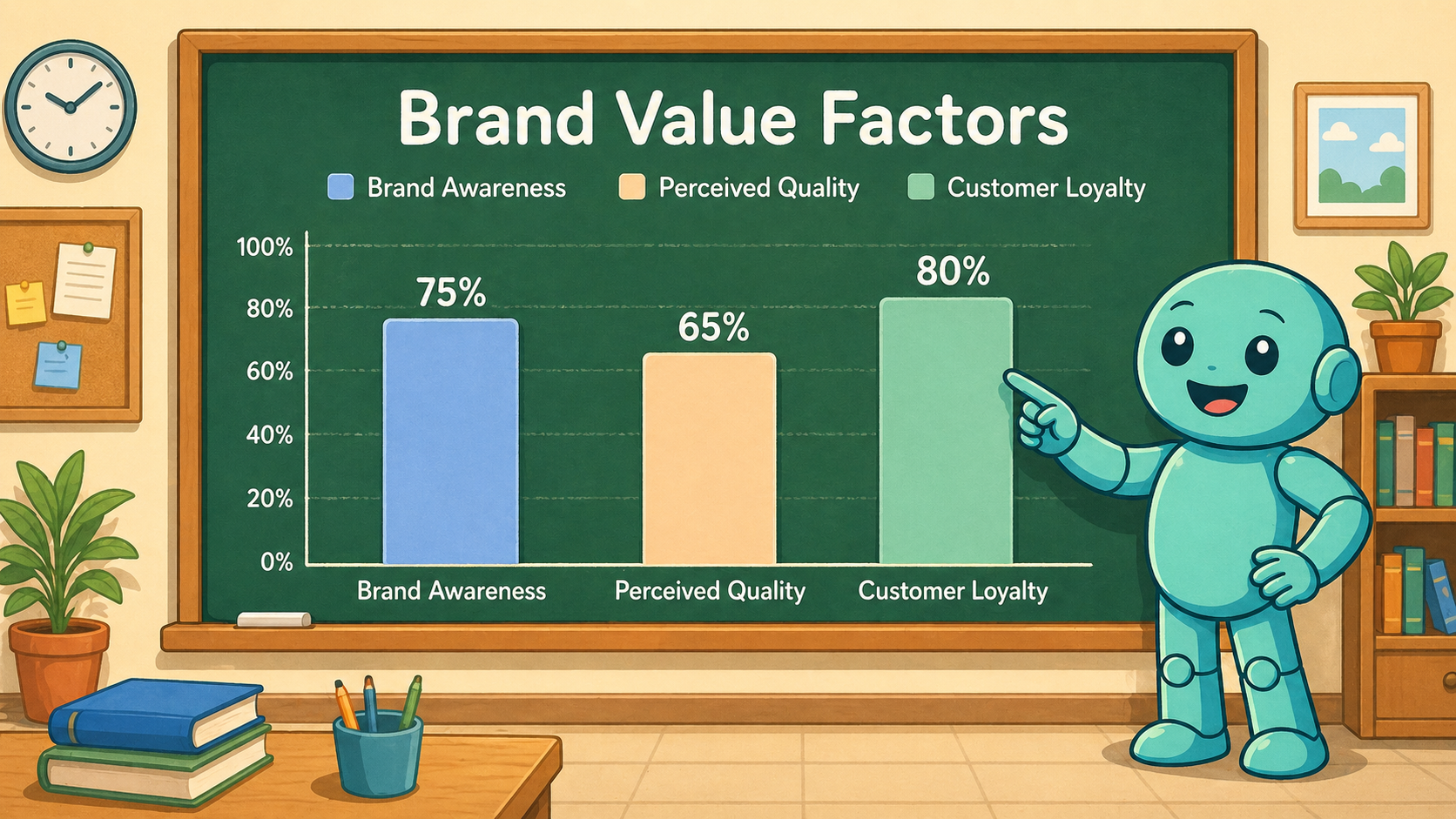
As you can see, factors like customer loyalty and awareness are powerful drivers of the predictable future earnings that this model relies on. High loyalty, in particular, is a cornerstone of a strong income-based valuation.
Comparing Brand Valuation Models
Deciding on a model isn't always straightforward. Each has distinct advantages and is suited for different business scenarios. This table offers a side-by-side comparison to help you see which method or combination of methods best aligns with your specific goals and available resources.
Valuation Model
| Core Principle
| Best For
| Limitation
|
|---|---|---|---|
Cost Approach
| Values the brand based on the total historical cost to create it.
| New businesses, internal accounting, or when no income/market data is available.
| Ignores future potential, customer goodwill, and the actual market value of the brand.
|
Market Approach
| Determines value by comparing the brand to recent sales of similar brands.
| Mergers & Acquisitions (M&A), licensing agreements, and litigation.
| Heavily dependent on the availability of comparable public transaction data, which can be scarce.
|
Income Approach
| Calculates value based on the net present value of forecasted future earnings attributable to the brand.
| Strategic planning, investor relations, and businesses with strong, predictable cash flow.
| Relies on forecasts and assumptions, which can be subjective and complex to calculate.
|
Ultimately, there's no single "correct" answer. The most sophisticated valuations often blend elements from different approaches to create a more holistic and defensible picture of a brand's true worth. The key is to understand what each model measures and align your choice with what you need to achieve.
Lessons From the Global Brand Value Landscape
To really get a handle on why measuring brand value matters so much, it helps to step back and look at the bigger picture. The numbers at play here aren't just big they're staggering. A brand today isn’t just a regional asset; it's a global economic force that can drive growth on an unbelievable scale.
Think about it: the world's most valuable brands are worth hundreds of billions of dollars. That's more than the GDP of many countries. This tells us that a strong brand is one of the most durable assets a company can have, often providing stability during tough economic times and fueling recovery afterward.
The Surge in Global Brand Worth
The growth trajectory of global brands tells a compelling story. Over a recent 15-year period, the combined value of the world's top 100 brands nearly tripled, shooting up from 1.5trillion∗∗toanincredible∗∗4.1 trillion. This explosion underscores just how much intangible assets, like reputation and customer loyalty, drive the modern global economy. For a deeper dive, you can read the full analysis of this brand value transformation.
Of course, this growth isn't spread evenly across the board, which points to some fascinating shifts in economic power. While the United States is still home to most of the world's top brands, other countries are quickly gaining ground.
A brand's ability to cross borders and connect with different cultures is a core driver of its financial valuation. In our interconnected world, the strongest brands build a consistent narrative that resonates everywhere, not just in their home market.
Emerging Markets and Shifting Dynamics
This shift is most dramatic when you look at China. Over that same 15-year span, China's presence among the top 100 global brands skyrocketed by a mind-boggling 8,696%. Chinese brands now account for nearly a quarter of the total value of this elite group, a powerful testament to their rapid innovation and growing international influence.
This fiercely competitive landscape is precisely why your own brand valuation is so critical. You aren't just up against local competitors; you're playing in a dynamic global arena. Here’s what these trends really mean for your business:
- Context for Your Valuation: Seeing these massive figures helps frame the real potential upside of investing in your brand.
- Competitive Benchmarking: It drives home the high stakes and the need to build a brand that can compete with powerful international players.
- Strategic Direction: It’s a clear signal that markets are constantly evolving. Building brand value is essential for securing long-term success.
At the end of the day, these global trends make one thing perfectly clear. Measuring your brand's value isn't just an internal accounting exercise. It's a fundamental practice for navigating and winning in a complex, competitive, and increasingly brand-centric world economy.
The Modern Tech Stack for Measuring Brand Value
Trying to manually cobble together all the data you need to measure brand value is an exercise in frustration. Thankfully, it's also a thing of the past. Today, we have an entire ecosystem of software that automates data collection and analysis, giving you a live, continuous feed of your brand's performance.
Putting together the right tech stack is what separates reactive brands from proactive ones. Instead of waiting for quarterly reports, you're building a real-time dashboard for your brand's health. This setup lets you draw a straight line from your marketing spend to tangible business results, turning abstract ideas like "brand perception" into cold, hard data.
Gathering Customer and Market Insights
The first part of your stack is all about listening, understanding what your audience truly thinks and says about you. This is where you get a handle on perception and your share of the conversation.
Social Listening Platforms: Tools like Brandwatch or Talkwalker are non-negotiable in my book. They sift through millions of online conversations to track brand sentiment, spot trends before they go mainstream, and see how your share of voice stacks up against the competition. You can literally watch how a new campaign lands or how public opinion shifts during a PR crisis, all in real time.
Survey Tools: To get feedback straight from the source, you'll want platforms like SurveyMonkey or Typeform. These are perfect for deploying Net Promoter Score (NPS) surveys, measuring customer satisfaction (CSAT), or even testing new brand messaging before a big launch.
Combining what you with what you directly gives you a powerful, well-rounded view of how your brand is perceived in the wild.
Think of your tech stack as your brand's central nervous system. It takes in signals from every corner of the market, customer chatter, competitor moves, internal performance and turns them into a single, unified picture of your brand's health.
Connecting Brand Activity to Business Results
Next, you need to connect the dots between brand strength and your bottom line. This is where you prove how a strong brand drives traffic, generates leads, and ultimately, makes the register ring.
Your web analytics suite, most commonly Google Analytics, is fundamental here. It’s not just about total traffic. I always recommend setting up custom segments specifically for branded search traffic. This tells you exactly how many people came to your site because they were actively looking for . It’s a crystal-clear indicator of brand recall and purchase intent.
When you pair this data with what's in your CRM, you can see precisely how that brand-driven traffic converts into actual revenue.
Of course, none of this works without a solid foundation. The importance of building a strong brand identity can't be overstated, as it ensures all the signals you're tracking are consistent and meaningful. You can learn more by exploring our detailed guide on creating a brand identity that truly resonates.
The economic impact is undeniable. The value of the world's top 5,000 brands shot up from 13 trillion USD by 2024. That’s a massive 20% jump in just four years, even with all the global economic turbulence. This growth shows just how resilient and vital well-managed brands are.
You can discover more insights about global brand value on WIPO.int. By building a modern tech stack, you're giving your business the tools it needs to track, nurture, and grow its most valuable asset.
Common Questions About Brand Valuation
When you start digging into brand valuation, a handful of questions almost always pop up. It doesn't matter if you're a startup founder or working inside a global giant; getting straight answers to these makes the whole process feel less abstract and more grounded. Let's tackle the big ones I hear most often.
One of the first hurdles is simply clarifying the language. Two terms, in particular, cause a lot of mix-ups.
What Is the Difference Between Brand Equity and Brand Value?
I like to think of it like this: brand equity is the a customer chooses you over a competitor, even when the products are similar. It’s all the intangible stuff, the gut feelings, perceptions, and deep-seated loyalty they have for your brand. It’s the influence you hold in their mind.
Brand value, on the other hand, is what happens when you put a price tag on that influence. It’s the process of translating all that goodwill into a concrete financial figure, an asset on the balance sheet. In essence, you build strong brand equity first, and that equity is what ultimately creates tangible brand value. One is about influence; the other is about its financial worth.
A strong brand is a protectable asset. Once you’ve built that value, it’s crucial to safeguard it legally. This is where intellectual property comes into play. For a detailed walkthrough, our guide on how to trademark a business name provides essential insights into securing your most valuable asset.
How Often Should a Company Measure Its Brand Value?
The right rhythm really comes down to your purpose. If you're doing this for formal financial reporting, a merger, or a big-picture strategic review, then an annual comprehensive valuation is the standard. This timing lines up neatly with yearly financial cycles and gives you a clean year-over-year benchmark for showing progress to stakeholders.
But you shouldn't just set it and forget it for 12 months. The vital signs that feed into your valuation, think Net Promoter Score (NPS), social media sentiment, or share of voice need a much closer eye. Monitoring these health metrics on a monthly or quarterly basis lets you make smart adjustments on the fly. It also means you won't have any nasty surprises when it's time for that full annual assessment.
Can a Small Business Realistically Measure Its Brand Value?
Absolutely. And it's not just possible; it's incredibly valuable. A small business doesn’t need the same heavyweight, income-based models a Fortune 500 company would use. It's all about focusing on practical metrics that tell the real story.
Instead of getting lost in complex financial forecasts, a smaller company can get a fantastic read on its brand's strength by tracking things like:
- Customer Lifetime Value (CLV): Are customers sticking with you and spending more over their lifetime?
- Repeat Purchase Rate: Do you have a loyal, returning customer base?
- Branded Search Traffic: How many people are searching for you by name?
- Social Media Engagement: Is your community active and growing?
For putting an actual number on it, the "Cost Approach" is often a great, straightforward place to start. Just estimate what it would cost to rebuild your brand from zero, your logo, website, customer lists, and reputation. This gives you a solid, defensible baseline for your brand's financial worth without needing a full-time team of analysts.
Ready to create a brand name that builds real value? The powerful tools at NameRobot can help you generate, evaluate, and secure a name that's not only creative but also market-ready and legally sound. Find your perfect name today at https://namerobot.com.